ElevenLabs vs PlayHT
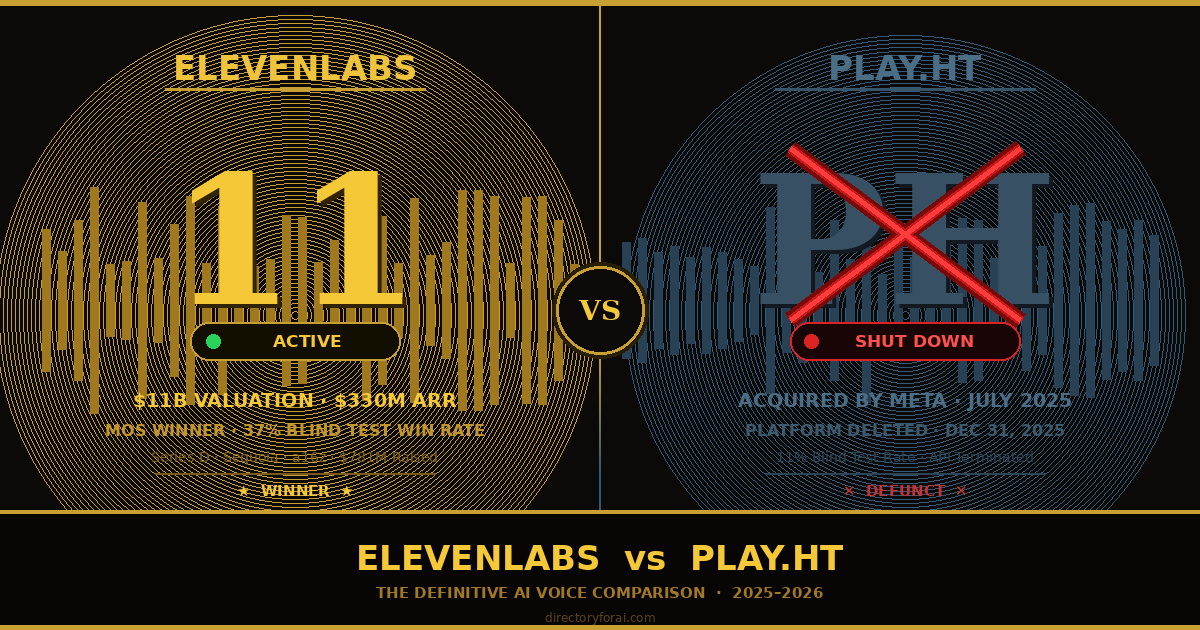
Everything changed in July 2025. Meta acquired PlayHT, shut down its API in weeks, and killed the platform entirely by December 31, 2025. If you landed here looking for a head-to-head between two active competitors, here is the honest version of this story — including what PlayHT was, why it mattered, how it stacked up before its shutdown, and what ElevenLabs has become since.
This article covers voice quality benchmarks, pricing breakdowns, feature comparisons, real user feedback, and a final verdict grounded in documented facts.
Background: Who Built These Platforms and Why It Matters
ElevenLabs was founded in 2022 by Mati Staniszewski (CEO, formerly at Palantir) and Piotr Dabkowski (CTO, formerly at Google). The company was established in New York City and initially launched with just 15 team members, no conventional office, and a focus on making AI-generated voices indistinguishable from human speech. Speechify In January 2023 the product went public and the growth was immediate.
By April 2025, ElevenLabs reached $100 million in revenue, which represented a 2,000% increase from its 2023 figures. Electro IQ That trajectory attracted serious capital. In January 2025, ElevenLabs raised a Series C of $180 million at a $3.3 billion valuation, co-led by a16z and ICONIQ Growth, with additional strategic investors including Deutsche Telekom, LG Technology Ventures, HubSpot Ventures, and NTT DOCOMO Ventures. TechCrunch
Then, in February 2026, the company announced a Series D that signaled an entirely different scale of ambition. ElevenLabs raised $500 million at an $11 billion valuation, led by Sequoia Capital, with participation from Andreessen Horowitz, ICONIQ, Lightspeed Venture Partners, Evantic Capital, and Bond. The round more than tripled the company’s valuation from January 2025. CNBC ElevenLabs closed 2025 with over $330 million in annual recurring revenue, driven by enterprise adoption from companies including Deutsche Telekom, Square, the Ukrainian Government, and Revolut. ElevenLabs
PlayHT had a very different origin story. Play.ht began in 2016 as a Chrome extension that enabled users to add audio to their Medium articles, founded by Syed Hammad Ahmed and Mahmoud Felfel. Speechify It grew into a full TTS platform with voice cloning, a WordPress integration, and a developer API — a solid product used by thousands of content creators, e-learning teams, and small agencies.
When Meta acquired PlayHT in July 2025, it sent shockwaves through the content creator community. The API went dark on July 26th, weeks ahead of schedule, and the entire platform shut down on December 31, 2025. Fliki
The entire PlayHT team, including its founders, joined Meta’s newly formed Superintelligence Labs. An internal Meta memo stated that PlayAI’s work was “a great match for our work and road map, across AI Characters, Meta AI, Wearables and audio content creation.” Skypage For Meta it was a talent acquisition. For PlayHT’s paying customers, it meant losing voice clones, API integrations, and account history with no migration path.
The Big Picture: Platform Status in 2026
| ElevenLabs | PlayHT | |
|---|---|---|
| Status | Active, growing | Shut down Dec 31, 2025 |
| Founded | 2022 | 2016 |
| Ownership | Independent (IPO-track) | Acquired by Meta July 2025 |
| Total Funding | $781 million | Undisclosed (acquihired) |
| Valuation | $11 billion (Feb 2026) | N/A |
| ARR (2025) | $330 million+ | Not disclosed publicly |
| API availability | Yes, active | No, terminated |
Voice Quality: Benchmarks and Data
This is where the comparison is most consequential, and where the numbers tell a clear story.
Mean Opinion Score (MOS) is the industry standard for evaluating perceived audio quality on a scale from 1 to 5, derived from blinded human evaluations.
Based on MOS evaluations, ElevenLabs generally offers higher voice quality across fiction, non-fiction, and conversation categories compared to Play.ht. ElevenLabs excels particularly in fiction, with a notable lead, suggesting that for projects requiring a high degree of emotional expression and intonation, ElevenLabs is the preferred choice. Unreal Speech
Play.ht’s voice quality scored a 3.8 MOS, which remains suitable for most commercial content. Their strength lies in workflow integration and accessibility rather than pushing the boundaries of voice AI technology. Aloa
Word Error Rate (WER) measures how accurately a TTS model reproduces intended speech, where lower is better.
ElevenLabs achieved a low Word Error Rate of 2.83%, indicating strong performance in minimizing hallucinations during speech generation. Cartesia
Blind listening tests provide perhaps the most practical measure.
In independent blind listening tests, ElevenLabs was chosen as the top voice 37 times compared to the next-closest competitor at 19, and achieved the lowest word error rate at 2.83% in Labelbox evaluations. On Poe.com, 80% of subscriber voice usage goes to ElevenLabs. ElevenLabs
A separate survey produced similar results. From survey results comparing multiple TTS services, ElevenLabs scored highest 37% of the time, while PlayHT only managed 11% of the time, a difference of 26%. ElevenLabs also outperformed each of the five other TTS services used in the survey. ElevenLabs
Voice Quality Benchmark Summary:
| Metric | ElevenLabs | PlayHT (at shutdown) |
|---|---|---|
| MOS Score | Higher across all categories | 3.8 |
| Word Error Rate | 2.83% | Not independently published |
| Blind test win rate | 37% (survey, multi-platform) | 11% |
| Pronunciation accuracy | 81.97% | Not detailed |
| Speech naturalness | 44.98% rated medium+ | Clear and engaging |
Feature Comparison
At their peak — when both platforms were active — their feature sets diverged considerably.
| Feature | ElevenLabs | PlayHT (before shutdown) |
|---|---|---|
| Voice library | 1,200+ voices | 832+ voices |
| Language support | 70+ (Eleven v3) | 142 languages |
| Instant voice cloning | Yes (30 seconds of audio) | Yes (10 instant clones on Creator) |
| Professional voice cloning | Yes (Creator plan+) | Limited |
| Voice cloning audio required | 30 seconds minimum | Several minutes |
| AI Dubbing | Yes (29 languages) | No |
| Sound effects generation | Yes | No |
| AI Music | Yes (launched July 2025) | No |
| Conversational AI agents | Yes (ElevenAgents) | No |
| Speech-to-text (Scribe) | Yes | No |
| Per-word timestamps | No | Yes |
| Speed control | Limited | Yes |
| Pitch control | Yes | Yes |
| WordPress integration | No native integration | Yes (WordPress plugin) |
| Team collaboration tools | Business plan+ | Available on Creator+ |
| API | Yes, comprehensive | Yes (shut down July 26, 2025) |
| Free plan | Yes | Was available |
| Commercial rights | Starter plan+ | Creator plan+ |
One practical capability gap: Play.ht distinguished itself with additional functionalities such as per-word timestamps and speed control, which were not available in ElevenLabs. However, ElevenLabs focused on delivering more natural-sounding voiceovers with higher mean opinion scores across different types of content. Unreal Speech
ElevenLabs has transformed from a TTS startup into a full AI audio platform. Their 2025–2026 expansions include Conversational AI for voice agents, AI Dubbing for video localization, Scribe v2 for speech-to-text, sound effects generation, and the ElevenReader app for text-to-audio consumption. Aloa
In-Depth Pricing Section
ElevenLabs Pricing (Current, 2026)
ElevenLabs restructured pricing in 2025, switching from characters to a unified credit system. The Starter plan ($5/month, 30,000 credits) includes instant voice cloning and commercial rights. The Creator plan ($11/month, 100,000 credits) adds professional voice cloning and higher quality output. Credits work across all services — TTS, conversational AI, and dubbing — with Turbo models consuming only 0.5 credits per character. Unused credits roll over for up to two months on active subscriptions. Aloa
| Plan | Monthly Price | Credits | Key Features |
|---|---|---|---|
| Free | $0 | 10,000/month | TTS, Speech-to-Text, no commercial rights |
| Starter | $5/month | 30,000/month | Commercial rights, instant voice cloning |
| Creator | $22/month | 100,000/month | Professional voice cloning, 192kbps audio |
| Pro | $99/month | 500,000/month | 44.1kHz PCM API audio, production scale |
| Scale | $330/month | Millions | Multi-seat, low-latency TTS |
| Business | $1,320/month | Very high volume | Priority support, early access |
| Enterprise | Custom | Custom | SSO, HIPAA/BAA, dedicated support, SLAs |
Credits: What they actually buy you. The Creator plan’s 100,000 credits translates to roughly 2.5 hours of audio using the highest quality model, or around 5 hours of audio using the Flash model, which costs 0.5 credits per character. Feisworld A single 10-minute narration consumes approximately 15,000 characters, meaning the Starter plan supports around two full narration videos per month at standard quality.
ElevenLabs also offers two free months on annual plan commitments and has run promotional pricing including 50% off the first Creator month.
PlayHT Pricing (Historical — Platform No Longer Active)
At its peak, PlayHT ran an annual subscription model. Play.ht’s Creator plan ($39/month) provided 600,000 characters per year with 10 instant voice clones. The Unlimited plan ($99/month) advertised unlimited generation but enforced a 2.5 million character monthly fair-use cap. It’s worth noting that character counts included punctuation, and regenerating audio consumed the full allocation again. Aloa
| Plan | Monthly Price | Characters | Key Features |
|---|---|---|---|
| Free | $0 | Limited | Basic TTS, no commercial rights |
| Creator | $39/month | 600,000/year | 10 instant voice clones, commercial rights |
| Unlimited | $99/month | 2.5M/month (fair use cap) | Unlimited generation (capped), team access |
| Enterprise | Custom | Custom | Advanced security, SSO, resell rights |
The character counting issue. PlayHT’s character limits included punctuation marks and spaces. Regenerating a clip counted as a new generation against the monthly quota. Users on the Creator plan received 600,000 characters annually, which works out to 50,000 per month — not a particularly generous allowance for high-volume content teams.
Price per character comparison (at time of both platforms being active):
At the Creator tier, PlayHT charged roughly $39/month for 50,000 characters monthly. ElevenLabs charged $22/month for 100,000 characters on the same tier. ElevenLabs was both cheaper and more generous at comparable usage levels.
ElevenLabs is more affordable at $5/month versus PlayHT’s former $39/month entry, higher quality, and offers a far broader feature set. ElevenLabs
Voice Cloning: A Direct Comparison
Voice cloning was a headline feature for both platforms. The gap in quality and accessibility was significant.
ElevenLabs voice cloning tiers:
ElevenLabs offers two tiers of voice cloning. Instant Voice Clone requires 1–5 minutes of audio and generates usable voices within minutes — available from the Starter plan ($5/month). Professional Voice Cloning, available on Creator ($11/month) and above, captures deeper vocal characteristics for more accurate reproduction. The quality preservation is exceptional, maintaining speaker characteristics, accent nuances, and emotional range. Aloa
In practice, ElevenLabs requires as little as 30 seconds for an instant clone — the minimum in the industry. Professional clones trained on longer samples capture intonation, accent nuance, and emotional range at a level independent reviewers have described as near-indistinguishable from the source.
PlayHT voice cloning (historical):
PlayHT offered cross-language voice cloning, which was genuinely differentiated. PlayHT offered robust cross-language voice cloning features and a multi-voice feature, allowing a speaker’s voice to generate audio in other languages. This capability was a key feature for e-learning and complex global audio projects. Fahim AI The Creator plan included 10 instant voice clones. However, the quality of those clones did not match ElevenLabs in blind listening evaluations.
API Comparison
For developers building voice applications, the API capabilities mattered more than the consumer interface.
ElevenLabs has built a comprehensive developer ecosystem. In November 2024, ElevenLabs released Conversational AI, a developer platform for launching interactive voice agents. In February 2025, the company introduced a platform enabling authors to create and publish AI-generated audiobooks directly on its Reader app. In June 2025, ElevenLabs released Eleven v3, a new text-to-speech model supporting more than 70 languages, natural multi-speaker dialogue, and audio tags like [excited], [whispers], and [sighs]. Wikipedia
PlayHT’s API, at its best, covered standard TTS endpoints with solid documentation. ElevenLabs’ API seamlessly integrates with other apps and products, supported by full documentation and robust support. PlayHT offered a comparable API for TTS integration, along with a Chrome extension for Medium blogging platform integration. ElevenLabs
The key difference is what happened next. PlayHT’s API was shut down on July 26, 2025 — weeks before the announced deadline — leaving developers mid-project with no warning. According to discussions on Reddit, users faced disruptions with PlayHT’s API going offline weeks ahead of the announced sunset date. Conversational AI platforms like Kore.ai had already recommended switching away from PlayHT. Murf AI
ElevenLabs API latency, for context: ElevenLabs demonstrated competitive latency performance using the Time to First Audio (TTFA) metric across 100 measurements at the 90th percentile. Cartesia The Flash model processes audio at roughly 4x the speed of the Multilingual v2 model.
Use Case Matchup
For Audiobook and Long-Form Narration
Winner: ElevenLabs. The MOS advantage in fiction narration is substantial and documented. The Studio tool handles long-form projects natively, with contextually aware voice delivery that adjusts tone across chapters. PlayHT could produce acceptable narration but never matched ElevenLabs on emotional range and consistency.
For E-Learning and Training Content
Pre-2025: Tie, leaning PlayHT. PlayHT’s 142-language support and WordPress integration were meaningful advantages for e-learning teams working inside existing content stacks. ElevenLabs’ voice quality was higher, but PlayHT’s workflow tooling was more practical for non-technical users producing bulk educational content.
Post-2025: ElevenLabs only. PlayHT no longer exists.
For Podcast Production
Winner: ElevenLabs. Both platforms supported podcast-style audio, but ElevenLabs’ voice naturalism and the ability to clone a host’s voice with professional accuracy made it better suited for listenable, long-form audio content.
For Developer API Integration
Winner: ElevenLabs (by default). PlayHT’s API is gone. ElevenLabs’ API is actively maintained, expanding, and now covers TTS, speech-to-text, dubbing, sound effects, and conversational agents from a single endpoint.
For WordPress Content Workflows
Historical winner: PlayHT. PlayHT had a native WordPress plugin and was built with content publishers in mind. Play.ht maintained its focus on content creator workflows with WordPress integration, team collaboration, and pronunciation control tools. Aloa ElevenLabs has no equivalent native WordPress integration.
For Conversational AI and Voice Agents
Winner: ElevenLabs. PlayHT never entered this space. ElevenLabs launched ElevenAgents, its enterprise conversational voice platform, in late 2024 and made it a central part of its 2026 funding story. With the Series D funding, ElevenLabs is doubling down on ElevenAgents, its enterprise platform for voice and conversational AI, to support customer experience, sales and marketing, and internal workflows with interactive voice agents. ElevenLabs
Platform Stability: The Critical Factor Nobody Talks About
The biggest real-world lesson from this comparison is not about voice quality or pricing. It is about what happens when a venture-backed startup gets acquired.
PlayHT gave users minimal notice. Play.ht was acquired by Meta in July 2025 and permanently shut down on December 31, 2025. All user accounts, saved audio, API endpoints, and voice clones were deleted. Notevibes Developers who had built products on PlayHT’s API, content teams who had painstakingly trained voice clones, and agencies running client projects all lost everything with no migration path.
Users were strongly advised to download any generated content they wished to keep before the final shutdown date of December 31, 2025. Once PlayHT shut down, it was gone. Skypage
ElevenLabs by contrast has $781 million in total funding, $330 million in annual recurring revenue, and a stated IPO trajectory. Tech giants like Meta and Salesforce use ElevenLabs’ voice infrastructure to develop products and experiences. CNBC Platform risk is substantially lower.
User Sentiment and Reviews
ElevenLabs on G2 and review platforms:
Customers appreciate ElevenLabs for its high-quality, realistic voice synthesis and the ease of creating and using different voices. The platform is praised for its user-friendly interface and excellent customer support. However, some users experience issues with pronunciation, emotional expression, and the pricing model, particularly regarding the cost-effectiveness of character counts and subscription tiers. There are also occasional technical glitches and a desire for more features like voice tone adjustments and better real-time performance. Snr
Specific technical complaints worth noting: the abuse detection system occasionally flags legitimate content; the credit system is perceived as complex; and some users report inconsistency across generation sessions using the same voice settings.
PlayHT on review platforms (historical):
User reviews in 2026 raised concerns about voice quality degradation during peak usage, customer support response times averaging 3–5 days, and a strict 24-hour refund policy. Aloa PlayHT was also criticized for limited emotional range compared to competitors — a gap that showed up clearly in blind listening studies.
Recent News and Developments
ElevenLabs (February 2026): ElevenLabs announced a major upgrade to its voice agents, enabling faster response times and improved expressiveness, powered by new turn-taking improvements and its Eleven v3 Conversational model. ElevenLabs
In March 2026, ElevenLabs pledged to commit $1 billion in free restoration voice technology to 1 million people living with permanent voice loss. Wikipedia
In August 2025, ElevenLabs launched Eleven Music, an AI music generator developed in collaboration with record labels, publishers, and artists, cleared for commercial use across film, television, podcasts, social media videos, advertisements, and gaming. Wikipedia
PlayHT (final timeline):
- July 12, 2025: Meta acquisition confirmed
- July 26, 2025: API shut down (ahead of announced schedule)
- August 2025: New sign-ups disabled
- October 2025: API deprecation notices sent to developers
- December 31, 2025: Platform fully shut down, all data deleted
Final Verdict: Matchup and Winner
Voice Quality: ElevenLabs wins. Consistently higher MOS scores across fiction, non-fiction, and conversational categories. A 2.83% Word Error Rate. A 37% win rate in blind multi-platform listening tests versus PlayHT’s 11%. The gap was real and documented before PlayHT’s shutdown.
Pricing: ElevenLabs wins (at comparable tiers). PlayHT’s Creator plan charged $39/month for 50,000 characters monthly. ElevenLabs charges $22/month for 100,000 characters on its Creator plan. ElevenLabs delivers more output at a lower price point and the credit rollover policy adds further flexibility.
Feature breadth: ElevenLabs wins. ElevenLabs offers 14 products that PlayHT never had: AI Dubbing across 29 languages with voice preservation, Sound Effects generation, AI Music, Conversational AI agents, and Speech to Text (Scribe). ElevenLabs
Language support: PlayHT won (historically). 142 languages versus ElevenLabs’ 70+ at the time of comparison. This was a genuine differentiator for multilingual workflows, particularly in e-learning.
WordPress / content workflow integration: PlayHT won (historically). ElevenLabs still has no native WordPress plugin.
Platform stability: ElevenLabs wins, decisively. $11 billion valuation. $330 million ARR. Active IPO planning. Backed by Sequoia, a16z, Nvidia, Lightspeed, and ICONIQ. PlayHT is gone.
Overall winner: ElevenLabs. And this is not a close call in 2026. Before the acquisition, PlayHT was a legitimate competitor in specific use cases, particularly for content publishers on WordPress and teams that prioritized language coverage over voice naturalism. After the acquisition, there is no comparison to make. ElevenLabs is the dominant independent voice AI platform, and by every measurable benchmark — quality, pricing, features, stability, and financial foundation — it leads the category.
Who Should Use What in 2026
Use ElevenLabs if you are building anything. For audiobooks, podcasts, video narration, developer APIs, conversational AI agents, content dubbing, or professional voice cloning, ElevenLabs is the most capable and financially stable platform on the market. The Creator plan at $22/month is the sweet spot for individual creators. The Pro plan at $99/month fits agencies and media teams producing high volumes of audio regularly.
If you were a PlayHT user, the migration path most people take is ElevenLabs, though Murf (for enterprise with Canva/PowerPoint integrations) and Descript (for combined audio/video editing workflows) are valid depending on your specific needs. Your PlayHT voice clones did not transfer. If you retained your original reference audio, you can recreate clones on ElevenLabs using Instant or Professional Voice Cloning within a few minutes.
The story of PlayHT versus ElevenLabs is ultimately a story about two different bets on where voice AI was going. PlayHT bet on content creator workflows and sold to the highest bidder. ElevenLabs bet on becoming the audio infrastructure layer for the entire internet and is on track for a public offering. One of those bets is still running.