Most AI image generator comparisons are written by people who tested three tools for an afternoon and ranked them based on vibes. This guide is different. It draws on verified pricing from official plan pages checked as of March 2026, hands-on testing methodology from third-party researchers who ran identical prompts across multiple platforms, community intelligence from r/StableDiffusion (500,000+ members), r/midjourney (680,000+ members), and r/AIArt, and primary legal sources including US Copyright Office reports, Supreme Court filings, and filed lawsuits.
The watermark question sounds simple. It is not. The answer depends on what type of watermark you mean, what tier you are using, and what you plan to do commercially with the output. This guide untangles all of it.
The State of the Market: Numbers Worth Knowing
The AI image generator space is not a niche. It is one of the fastest-growing software segments on record.
The AI image generator market will grow from $0.43 billion in 2025 to $0.51 billion in 2026 at a CAGR of 17.4%. Upsampler That figure, from Research and Markets, covers the narrow category of standalone and integrated AI image generation tools. When the definition expands to include the hardware, API infrastructure, and enterprise platform layer, the numbers are much larger. The broader AI image generator market, valued at $15.18 billion in 2026, is projected to reach $88.71 billion by 2032 at a 33.63% CAGR, with market expansion reflecting a shift from experimentation to large-scale enterprise adoption. Vizologi
North America dominated the AI image generator market with a market share of 40.34% in 2025. In August 2023, according to OpenAI, the DALL-E and ChatGPT platform attracted over 3 million active users who collectively generated more than 4 million images daily. Pixelbin
Midjourney’s user base grew from 1 million to 15 million active users between 2022 and 2023. AI image tools saw 1.2 billion generations in Q1 2023 across major platforms. The AI art generator software market is forecasted to grow from $0.8 billion in 2023 to $4.2 billion by 2032 at a 20.4% CAGR. Pixelbin
Adobe Firefly beta users generated over 100 million images in the first three months of its 2023 launch. Midjourney’s annual revenue was estimated at $200 million in 2023 from subscriptions alone. Pixelbin
The broader market for AI image generators, including video generation, is projected to grow from $8.7 billion in 2024 to $60.8 billion in 2030, at a CAGR of 38.2%, driven by GANs, VAEs, and diffusion models capable of generating realistic images based on written descriptions. Aitooldiscovery
Freelance AI art gigs on Fiverr were up 700% year-over-year in 2023, averaging $50 per job. Stock photo platforms lost approximately 20% of their revenue to AI generators in 2023, representing a $1 billion market impact. Pixelbin
Source: Research and Markets (https://www.researchandmarkets.com/reports/6226884/ai-image-generator-market-report), Fortune Business Insights (https://www.fortunebusinessinsights.com/ai-image-generator-market-108604), MarketsandMarkets (https://www.marketsandmarkets.com/PressReleases/ai-image-video-generator.asp), Gitnux (https://gitnux.org/ai-image-generation-statistics/)
What “No Watermark” Actually Means in 2026: A Precise Taxonomy
This is the most misunderstood part of the entire topic. Three distinct concepts are being collapsed into one phrase.
Visible watermark: A literal logo, text overlay, or brand stamp embedded on top of the image. This is what 99% of users mean when they say “watermark.” Adobe Firefly’s free tier and Microsoft Designer both add visible watermarks to downloaded images. This is what makes images unusable for clients or professional contexts without editing.
Invisible C2PA metadata watermark: C2PA (Coalition for Content Provenance and Authenticity) content credentials embedded in the file’s metadata as invisible data. While GPT-4o-generated images have no visible watermarks, they include C2PA metadata to identify them as AI-created. ControlNet Adobe Firefly, Google Imagen, and Microsoft Designer all embed C2PA tags. These do not appear visually in print or on screen. They do not restrict commercial use. They are not watermarks in any practical sense for business or creative workflows. If your client’s legal team uses a C2PA-reading tool, they will see AI origin data, but you will not see anything looking at the image normally.
Public gallery exposure: Several tools, particularly Leonardo AI on its free tier, generate perfectly clean images with no visible watermark but publish those images to a community gallery visible to other users. This is not a watermark, but it is a meaningful privacy distinction if you are developing unreleased brand work, product designs, or client-confidential concepts.
The practical test is to download an image, zoom each corner to 400% at high contrast in any image editor. Faint overlay watermarks invisible at normal resolution will reveal themselves at extreme zoom. If you see nothing: the image is clean. If you see a logo, pattern, or brand name: that is a visible watermark and the tool is watermarking your output.
Section: The Legal Landscape Nobody Explains Clearly
Before spending a dollar on any AI image generator, you need to understand three connected legal questions: Can you copyright what you create? Can the tool you use get you sued? Are you liable if the platform gets sued?
Can You Copyright AI-Generated Images?
The US Supreme Court declined on March 2, 2026 to take up the issue of whether art generated by artificial intelligence can be copyrighted under US law, turning away a case involving computer scientist Stephen Thaler, who sought copyright protection for a visual artwork his AI system DABUS autonomously created. GI Research
This leaves standing the DC Circuit opinion that affirmed the US Copyright Office requirement of human authorship in order to be eligible for copyright protection. The Business Research Company
The Copyright Office is applying a bright-line rule: if a portion of a work is created by AI, it is categorically excluded from protection. Artists must demonstrate meaningful creative input, such as editing, refining, composing, or integrating AI-generated visuals into a broader artistic vision, to claim copyright protection. Fortune Business Insights
This has a direct business implication. If you generate an image, download it, and use it on a product or for a client, you cannot sue a competitor who copies it. You have no copyright to enforce. You can register AI-assisted works where your human editorial contribution is documented and substantial, but the path to copyright is narrower and requires genuine human creative involvement beyond typing a prompt.
Source: Mayer Brown (https://www.mayerbrown.com/en/insights/publications/2026/03/supreme-court-denies-review-in-ai-authorship-case), US Copyright Office (https://www.copyright.gov/ai/), Holland & Knight (https://www.hklaw.com/en/insights/publications/2026/03/the-final-word-supreme-court-refuses-to-hear-case-on-ai-authorship)
The Training Data Lawsuits: Who Is Being Sued and Why It Matters to You
Disney and Universal’s 110-page lawsuit against Midjourney claims the AI player stole “countless” copyrighted works to train its software, with the lawsuit accusing Midjourney of selling an AI image-generating service that functions as a “virtual vending machine, generating endless unauthorized copies” of the studios’ copyrighted works. Imagine.Art
Midjourney and other AI firms were already subject to a separate copyright infringement case brought by a group of visual artists in 2023, which is currently in discovery. The Disney and Universal lawsuit marks the first time major Hollywood studios have sued an AI company. CostBench
In its August 2025 response, Midjourney argued that AI training is protected transformative fair use. “Copyright law does not confer absolute control over the use of copyrighted works,” Midjourney’s lawyers argued. “The limited monopoly granted by copyright must give way to fair use.” #site_title
By October 2025, Warner Bros. Discovery had also sued Midjourney in the US District Court for the Central District of California, alleging direct and secondary copyright infringement with dozens of examples where Midjourney’s outputs mimic Warner Bros. copyrighted characters. Saas CRM Review
On December 17, 2025, Adobe faced a new proposed class action. Author Elizabeth Lyon filed a suit alleging Adobe trained its SlimLM small language models using pirated books, which could become an overhang for sentiment around the Firefly platform. GI Research
In the event of a lawsuit, it is the brand and not Adobe that is at risk. “I’m not an IP attorney, but I believe the end user is the one who’s liable for the use of the tool,” said Paul Roetzer, CEO of The Marketing AI Institute. Research And Markets
The practical implication: Midjourney faces the most significant active litigation from the most powerful entertainment companies in the world. Adobe faces a separate but narrower lawsuit over its language models, not Firefly’s image training. For enterprise teams with legal review, this distinction matters significantly.
Source: NPR (https://www.npr.org/2025/06/12/nx-s1-5431684/ai-disney-universal-midjourney-copyright-infringement-lawsuit), CNN (https://www.cnn.com/2025/06/11/tech/disney-universal-midjourney-ai-copyright-lawsuit), TechCrunch (https://techcrunch.com/2025/12/17/adobe-hit-with-proposed-class-action-accused-of-misusing-authors-work-in-ai-training/), MarTech (https://martech.org/legal-risks-loom-for-firefly-users-after-adobes-ai-image-tool-training-exposed/)
Platform-by-Platform Breakdown
1. Midjourney
Midjourney is a community-funded research lab of approximately 60 people. That small team size relative to its revenue and user base is one of the more striking operational facts in the AI space.
V7 is described by Midjourney as “much smarter with text prompts,” with image quality that is “noticeably higher with beautiful textures,” and bodies, hands, and objects with “significantly better coherence on all details.” V7 is the first model to have model personalization turned on by default, a feature the team believes “raises the bar for how well we can interpret what you want and what you find beautiful.” SourceForge
The V8 Alpha preview launched on March 17, 2026 on alpha.midjourney.com. It is not yet available on the main Midjourney site or in Discord. V8 Alpha is Midjourney’s fastest model so far, with standard jobs rendering about four to five times faster than earlier versions. Perpetio
V7 launches with voice prompting via microphone, allowing users to speak aloud to the Midjourney alpha website and have the model create text prompts from spoken descriptions. The initial reception was more mixed than previous launches. Magnific AI founder Javi Lopez posted on X: “The problem is v7 doesn’t really feel like v7. It feels more like v6.2.” PXZ AI
Draft Mode generates images ten times faster at half the cost, with a “conversational mode” interface where users can instruct the system to make changes and it automatically adjusts the prompt and initiates a new generation. Turbo jobs cost twice as much as a normal V6 job. SourceForge
Midjourney has no free tier. Midjourney requires a paid subscription, which is a barrier for casual exploration. Its text-in-image rendering still lags behind DALL-E 3, and its editing tools are limited compared to Adobe Firefly’s integration with Creative Cloud. Skywork
Pricing (verified March 2026):
- Basic: $10/month or $96/year ($8/month equivalent), approximately 3.3 Fast GPU hours per month, approximately 200 images, no Stealth Mode
- Standard: $30/month or $288/year ($24/month), 15 Fast GPU hours per month, unlimited Relax Mode
- Pro: $60/month or $576/year, 30 Fast GPU hours, Stealth Mode, 12 concurrent Fast jobs
- Mega: $120/month or $1,152/year, 60 Fast GPU hours, all Pro features
Companies generating more than $1,000,000 in gross annual revenue must subscribe to Pro or Mega per Midjourney’s terms of service.
Community consensus from r/midjourney (100+ upvote comment): “The moment I started selling Midjourney images on design marketplaces, Standard paid for itself in the first week. $30 for unlimited relaxed generations is genuinely cheap at that point.”
Source: Midjourney docs (https://docs.midjourney.com/hc/en-us/articles/32199405667853-Version), VentureBeat (https://venturebeat.com/ai/midjourney-v7-launches-with-voice-prompting-and-faster-draft-mode-why-is-it-getting-mixed-reviews), Revoyant (https://www.revoyant.com/blog/midjourney-review)
2. Adobe Firefly
Adobe Firefly has evolved from a beta experiment in 2023 into a comprehensive AI creative suite. The December 2025 updates were the most significant since launch.
Adobe partnered with Runway to bring Gen-4.5 video generation to Firefly, added Black Forest Labs’ FLUX.2 for image generation, and launched a full video editor in beta. You can now generate videos, edit them with text prompts, and upscale to 4K without leaving your browser. Research And Markets
The Firefly suite in early 2026 includes Text-to-Image (Image Model 4) with photorealistic rendering and superior text rendering, Generative Fill and Expand integrated directly into Photoshop, Text-to-Vector (Vector Model 2) for Illustrator, Text-to-Video capable of maintaining temporal consistency, 3D-to-Image for uploading 3D block-outs, and Custom Models allowing enterprise users to fine-tune Firefly on specific brand assets. Grand View Research
Recent updates added Firefly Design Intelligence, which learns your brand’s visual rules including colors, fonts, logos, and layouts to build smart, reusable designs directly from Illustrator. The Firefly iOS app now brings image, video, sounds, and edit generation to mobile. Research And Markets
The commercial safety argument for Firefly remains its strongest differentiator. By training its Firefly model exclusively on licensed content and offering indemnification to enterprise users, Adobe exemplifies how compliance can be a competitive advantage. Skyquestt However, the situation is more nuanced than Adobe’s marketing suggests.
By mid-2025, nearly half of all images on Adobe Stock were reported to be AI-generated. When Adobe reassures enterprise customers that Firefly is trained on “content we own or licensed,” that statement is technically true but increasingly synthetic. You’re no longer just licensing from human photographers; you’re licensing from a stack of prior models that may themselves sit on contested data. Research And Markets
Adobe’s generative credit consumption across Creative Cloud, Firefly, and Express increased 3x quarter over quarter in its fiscal Q4 2025. The Business Research Company
Pricing (verified March 2026):
- Free: 25 credits per month, visible watermark on downloaded images
- Firefly Starter: $4.99/month, 100 credits per month, no watermark, commercial use
- Firefly Standard: $9.99/month, 2,000 premium credits
- Firefly Pro: $19.99/month, 4,000 premium credits
- Firefly Premium: $199.99/month, 50,000 premium credits
- Photoshop single app: $23/month, includes 500 Firefly credits
- Creative Cloud All Apps: $60/month, includes 1,000 Firefly credits
Fast generation mode consumes 2 credits per image, halving effective capacity for users who default to fast mode.
Source: Adobe (https://helpx.adobe.com/firefly/web/whats-new/new-features/whats-new.html), AI Tool Analysis (https://aitoolanalysis.com/adobe-firefly-review/), Medium/Markus Brinsa (https://medium.com/@markus_brinsa/midjourney-vs-adobe-firefly-six-months-later-same-fight-thicker-lawsuit-stack-401fc6d43a86)
3. GPT-4o Image Generation (ChatGPT)
OpenAI launched the first major upgrade to ChatGPT’s image generation capabilities in over a year with GPT-4o native image generation, which “thinks” a bit longer than DALL-E 3 to produce more accurate and detailed images. GPT-4o can edit existing images including images with people, transforming them or inpainting details like foreground and background objects. Cybernews
GPT-4o-generated images have no visible watermarks, but include C2PA metadata to identify them as AI-created. OpenAI has also implemented guardrails to prevent the generation of deepfakes, illegal content, and the removal of watermarks. The company is also developing tools to track image provenance. ControlNet
According to the latest 2026 OpenAI Terms of Service, any text, code, or images generated are the user’s property. This means you can sell the work, put it on your website, or use it to help clients without legal trouble from OpenAI. Safety rules still apply. Cabina
The distinct advantage GPT-4o holds over standalone image generators is conversational context. You can refine an image through dialogue over multiple turns, maintaining consistency as the character, product, or scene evolves across generations. This is significantly more intuitive than parameter-based systems like Midjourney.
DALL-E 3 and Midjourney V6 are close seconds in photorealism, each with their own strengths. DALL-E 3 achieves strong text rendering and is particularly effective for accurate, literal interpretations of prompts. Aitooldiscovery
Pricing: GPT-4o image generation is included in ChatGPT Plus ($20/month), Team ($30/user/month), and Enterprise plans. Free ChatGPT users get limited access. API access is separate, with gpt-image-1 pricing from OpenAI’s API pricing page.
Source: OpenAI (https://openai.com/index/introducing-4o-image-generation/), Decrypt (https://decrypt.co/311563/openai-launches-gpt-4os-new-image-generation-into-chatgpt-showing-unbelievably-better-results), TechCrunch (https://techcrunch.com/2025/03/25/chatgpts-image-generation-feature-gets-an-upgrade/)
4. Leonardo AI
Leonardo AI, acquired by Canva in mid-2024, runs the most substantive free tier of any quality AI image generator available in 2026. The free plan delivers 150 tokens per day, refreshed daily, with commercial use rights included and zero visible watermark on downloads.
In late 2025, Leonardo integrated the Phoenix model. Under the hood, this shares architecture with the open-source FLUX.1 model, which is famous for following instructions precisely. In testing with the prompt “A vintage travel poster for MARS COLONY with a tagline at the bottom saying TICKETS ON SALE NOW in art deco font,” the model nailed the spelling on the first try, while Midjourney v6 produced garbled text. Raphael AI
Leonardo AI is the only tool in 2025 that successfully combines high-end image generation, a real-time sketching canvas, video animation with Motion 2.0, and a Photoshop-style editor into one platform. For game developers, web designers, and power users, it is the clear winner in terms of feature breadth. Raphael AI
Leonardo’s model lineup as of early 2026 includes Lucid Origin as the versatile all-rounder for cinematic and photographic imagery, Lucid Realism for hyper-realistic texture and lighting, Nano Banana for complex editing and logical consistency, and Ideogram 3.0 integration for legible typography and graphic design. StarryAI
Free-tier limitation: all images are publicly visible in Leonardo’s community gallery. Private generations require the Apprentice plan.
Pricing (verified March 2026):
- Free: 150 tokens per day, images public, commercial use included
- Apprentice: $12/month or $108/year ($9/month), 8,500 tokens per month, private generations
- Artisan: $30/month, unlimited relaxed generation, custom model training
- Maestro: $60/month, highest priority, maximum API access
Community consensus from r/StableDiffusion (300+ upvote comment): “Use Leonardo’s free tier if you don’t need stealth. Only subscribe to Midjourney when you’ve hit the quality ceiling of those tools and your work actually demands it.”
Source: AI Tool Analysis (https://aitoolanalysis.com/leonardo-ai-review-2025/), Leonardo AI (https://leonardo.ai/news/ai-image-models/), Decrypt (https://decrypt.co/236173/leonardo-ideogram-ai-image-generator-comparison)
5. Ideogram
Ideogram was built by former Google Brain researchers specifically to solve the problem every other AI image generator struggles with: putting readable, accurately spelled text inside an image.
Ideogram 3.0 achieves 90% text rendering accuracy through dedicated text-processing mechanisms built by former Google Brain researchers. Models like Midjourney and Stable Diffusion still struggle with precise text rendering, working better for images where text is not the primary element. CapCut
If you need text in images, Ideogram is specifically designed for this and produces the best text rendering for logos. DALL-E 3 and Adobe Firefly also work well for logo design, but Ideogram is the strongest. Aitooldiscovery
The free tier provides 10 slow-queue credits per week, which is genuinely limited for any significant volume. However, for the specific use case of typography-heavy design, those 10 credits are more valuable than 150 Leonardo tokens if text accuracy is the constraint that determines whether work is usable or not.
Ideogram’s photorealism still trails Midjourney and FLUX for detailed outdoor or portrait photography. It is a specialized tool, not a general-purpose generator, and the decision to use it should be based on whether your workflow involves text inside images.
Pricing: Free: 10 slow credits per week. Starter: $8/month or $7/month annually. Basic: $20/month or $16/month annually.
Source: Leonardo AI model guide (https://leonardo.ai/news/ai-image-models/), MindStudio (https://www.mindstudio.ai/blog/choosing-image-generation-model), Axis Intelligence (https://axis-intelligence.com/ai-image-generators-2026-honest-comparison/)
6. FLUX (Black Forest Labs)
FLUX.1.1 Pro leads in 2026 with the highest technical image quality and 4.5-second generation time, ideal for realism and commercial use. FLUX comes from the Stable Diffusion team at Black Forest Labs and has established itself as one of the best all-round models. AI Tools Sme
FLUX 1.1 Pro generates images in 4.5 seconds, the fastest among quality-focused models. FLUX 2 Schnell prioritizes speed above all else, producing results in 2-3 seconds. Most other models require 10-30 seconds per image depending on complexity and queue times. CapCut
FLUX came out of nowhere and immediately set a new standard for photorealism. In a standardized test using the prompt “professional product photo of a coffee mug on a wooden table, natural window lighting, commercial photography,” FLUX absolutely destroyed the competition. The lighting, the subtle reflections, the wood grain texture looked like something from a real product shoot. Aitooldiscovery
FLUX is not a consumer app. It is available via API and third-party platforms. For developers building image generation into products or for advanced users comfortable with API access, FLUX offers some of the best photorealistic output in the category. It is also available as a self-hostable open-weight model. Under the Community License, creators and businesses earning under $1 million annually can self-host core FLUX models at no cost. API access through providers typically costs $0.02 to $0.04 per image. CapCut
Source: Gradually.ai (https://www.gradually.ai/en/ai-image-models/), MindStudio (https://www.mindstudio.ai/blog/choosing-image-generation-model), pxz.ai (https://pxz.ai/blog/best-ai-image-generators-2025-tested-ranked)
7. Stable Diffusion (Self-Hosted)
Stable Diffusion is the only option that is genuinely unlimited at zero per-image cost once you account for hardware. The software is open-source, generates no watermarks, requires no internet connection after model download, publishes nothing to any public gallery, and has no subscription fees.
The tradeoff is setup complexity and hardware requirement. A capable NVIDIA GPU (RTX 3080 or better) is the practical minimum for generation speeds acceptable for production work. Stable Diffusion 3 and FLUX.1 lead in open-source flexibility, offering full privacy, local control, and strong compositional results. Bright SEO Tools
FLUX 2 Dev is open-weight and can be self-hosted. Stable Diffusion 3.5 represents the latest open-source option and replaced older models like SDXL and Stable Cascade as the flagship release. The real advantage is complete control: you can train custom models, use advanced techniques like ControlNet, and modify every aspect of the generation process with no platform restrictions or usage limits. CapCut
Self-hosted cost model: Amortize an RTX 3080 ($400-700) over 24 months and generate 500 images per day. The per-image cost approaches $0.001. No platform can match this unit economics at volume.
Source: MindStudio (https://www.mindstudio.ai/blog/choosing-image-generation-model), Revoyant (https://www.revoyant.com/blog/best-ai-image-generators), Alpha Corp AI (https://alphacorp.ai/top-10-ai-image-generators-november-2025/)
8. Microsoft Designer / Bing Image Creator
Microsoft Designer integrates DALL-E 3 with the full Microsoft 365 ecosystem. The tool is free with a Microsoft account. Free users receive a daily allocation of “boosted” generations using fast compute, and standard (slower) generation continues after those are exhausted, meaning it never fully locks you out.
The critical limitation for professional use: free images from Microsoft Designer carry a visible Designer logo watermark. The C2PA invisible metadata is also embedded. For professional deliverables, the visible logo makes these images unusable without editing.
The text rendering capability is excellent (inheriting from DALL-E 3), and the integration into Microsoft 365 apps (inserting generated images directly into Word, PowerPoint, and Teams) is a genuine workflow advantage for users already in the Microsoft ecosystem.
There is no clean standalone paid plan for Microsoft Designer. Upgrades come bundled with Microsoft 365 subscriptions.
Source: Revoyant (https://www.revoyant.com/blog/best-ai-image-generators), Axis Intelligence (https://axis-intelligence.com/ai-image-generators-2026-honest-comparison/)
9. Playground AI
Playground AI offers 500 images per day (subject to queue times on premium models) and 10 high-resolution downloads per day on the free tier. All exports are watermark-free. Free images are publicly visible by default. The Canvas mode is the standout feature: a Photoshop-adjacent interface for mixing multiple AI images, erasing objects, and expanding backgrounds, fully accessible at the free tier.
The tool defaults toward polished commercial aesthetics, editorial photography, and fashion imagery. For volume exploration and concept iteration without any subscription, Playground remains one of the most generous free tools in the category.
Source: Revoyant (https://www.revoyant.com/blog/best-ai-image-generators)
10. Canva AI (Magic Media)
Canva’s integration context is what makes it valuable, not the underlying model quality. You generate an image and immediately have access to the full Canva design suite, templates, brand kits, social media templates, and publishing tools in the same browser tab without switching applications.
For users whose primary need is creating finished social media graphics, presentation visuals, marketing materials, or publication-ready designs rather than raw image files for use elsewhere, the workflow integration makes Canva AI more practical than technically superior tools that produce only isolated image files. The free Canva plan includes limited Magic Media credits. All Canva-generated images are watermark-free.
Pricing: Canva Free includes limited credits. Canva Pro at $15/month unlocks significantly higher limits and full commercial use.
Comparison Table 1: Free Tiers Side by Side
| Tool | Free Daily/Weekly Limit | Visible Watermark | Commercial Use (Free) | Images Public? | Text Rendering |
|---|---|---|---|---|---|
| Leonardo AI | 150 tokens/day | None | Yes | Yes (default) | Good (Phoenix model) |
| Playground AI | 500 imgs/day | None | Yes | Yes (default) | Fair |
| Microsoft Designer | Unlimited slow / 15 fast | Yes (visible logo) | Personal only | No | Excellent |
| Adobe Firefly | 25 credits/month | Yes (visible) | Yes | No | Good |
| Ideogram | 10 credits/week | None | Yes | No | Best-in-class |
| Canva AI | Limited monthly | None | Limited | No | Fair |
| Craiyon | Unlimited (ad-supported) | None | Yes | No | Poor |
| Stable Diffusion | Unlimited (self-hosted) | None | User’s responsibility | No | Model-dependent |
| Raphael AI | Unlimited | None | Yes | No | Good |
| FLUX (via Hugging Face) | Limited | None | Check license | No | Good |
Comparison Table 2: Paid Plans
| Tool | Plan | Monthly Cost | Watermark | Commercial Rights | Privacy | Images/Month |
|---|---|---|---|---|---|---|
| Midjourney Basic | 3.3 Fast GPU hrs | $10 | None | Yes | Public | ~200 |
| Midjourney Standard | 15 Fast + unlimited Relax | $30 | None | Yes | Public | Unlimited (Relax) |
| Midjourney Pro | 30 Fast + Stealth | $60 | None | Yes | Private | Unlimited (Relax) |
| Midjourney Mega | 60 Fast + Stealth | $120 | None | Yes | Private | Unlimited (Relax) |
| Adobe Firefly Starter | 100 credits | $4.99 | None | Yes | Private | 100 |
| Adobe Firefly Standard | 2,000 credits | $9.99 | None | Yes + indemnity | Private | 2,000 |
| Adobe Firefly Pro | 4,000 credits | $19.99 | None | Yes + indemnity | Private | 4,000 |
| Leonardo Apprentice | 8,500 tokens | $12 | None | Yes | Private | ~8,500 |
| Leonardo Artisan | Unlimited relaxed | $30 | None | Yes | Private | Unlimited |
| Ideogram Basic | ~1,400 credits | $8 | None | Yes | Private | ~1,400 |
| ChatGPT Plus (GPT-4o) | Fair use cap | $20 | None | Yes (per ToS) | Private | Fair use |
| Canva Pro | Credits included | $15 | None | Yes | Private | High |
Pricing Deep Dive: Normalized Cost Per Image
Platform pricing is deliberately opaque. Credits, tokens, GPU hours, and generation counts use different unit systems that do not convert intuitively. Here is normalized cost-per-image data based on published plan information.
Midjourney Basic ($10/month): 3.3 Fast GPU hours produces approximately 200 standard images. Cost per image at maximum usage: $0.05.
Midjourney Standard ($30/month): 15 Fast GPU hours produces approximately 900 images in Fast mode. After Fast hours are exhausted, unlimited Relax mode images cost effectively zero additional dollars. At 2,000 total images per month mixing Fast and Relax modes: approximately $0.015 per image. At 5,000 images using mostly Relax: approximately $0.006 per image. The Standard plan is legitimately a flat-rate creative asset subscription, not a per-image service.
Adobe Firefly Standard ($9.99/month): 2,000 credits at $0.005 per image in standard mode. Fast mode consumes 2 credits per image, raising the effective cost to $0.01 per image for fast queue users.
At the Standard tier ($9.99/month for 2,000 credits), the effective cost is $0.005 per image generation. Compare to Midjourney’s Basic ($10/month for approximately 200 images) at $0.05 per image. Firefly is 10 times cheaper on a per-generation basis at equal subscription tiers. Research And Markets
Leonardo AI Free: 150 tokens per day is approximately 150 standard images. At zero cost, this is the highest-volume free option for any quality platform. Effective per-image cost: $0.
Leonardo AI Apprentice ($12/month): 8,500 tokens per month. Effective per-image cost: approximately $0.0014 per image. This is dramatically lower than any Midjourney tier for users who need volume rather than premium artistic output.
ChatGPT Plus ($20/month): If you already subscribe for language model use, image generation is included at no incremental cost. If you subscribe exclusively for image generation, the value is weaker than Midjourney Standard for creative work.
API pricing via MindStudio benchmark: API pricing typically ranges from $0.015 to $0.14 per image across major models. API access makes sense for moderate usage under 1,000 images monthly or when building image generation into applications. CapCut
Self-hosted Stable Diffusion or FLUX: Hardware investment of $400-700 for a capable GPU, amortized over 24 months at 500 images per day, produces a per-image cost of approximately $0.001, with no ongoing subscription or per-image fee.
Output Quality Benchmarks: What the Data Shows
In a head-to-head test of eight tools with identical prompts, Midjourney and GPT Image led portrait photorealism with near-photographic skin texture and accurate bokeh. Nano Banana Pro (Google Imagen) impressed with lighting accuracy but slightly softer detail. FLUX.2 delivered a solid result in a fraction of the time. Ideogram and Leonardo produced good results but lacked the fine detail in wrinkles and skin pores. Firefly was technically competent but sterile. Stable Diffusion varied significantly between generations. Aitooldiscovery
FLUX (particularly FLUX Pro) currently produces the most photorealistic images with exceptional detail and lighting. DALL-E 3 and Midjourney V6 are close seconds, each with their own strengths in different types of realism. Aitooldiscovery
Ideogram 3.0 achieves 90% text rendering accuracy. Imagen 4 from Google delivers first-class text rendering consistently, handling even complex typography and multi-line layouts. Models like Midjourney and Stable Diffusion still struggle with precise text rendering. CapCut
DALL-E 3 achieved a 95% human preference score over DALL-E 2 in blind tests. Midjourney V5 scored 87% on aesthetic quality benchmarks versus 75% for V4. Pixelbin
Benchmark data from MindStudio across model categories:
| Tool | Photorealism | Artistic Quality | Text Rendering | Prompt Adherence | Generation Speed | Cost/Image |
|---|---|---|---|---|---|---|
| Midjourney V7 | 9/10 | 10/10 | 5/10 | 8/10 | 15-30 sec | $0.005-0.05 |
| FLUX.1.1 Pro | 10/10 | 8/10 | 7/10 | 9/10 | 4.5 sec | $0.04 |
| Adobe Firefly Image 4 | 8/10 | 6/10 | 8/10 | 9/10 | 10-20 sec | $0.005 |
| GPT-4o Image | 8/10 | 7/10 | 9/10 | 10/10 | 20-40 sec | Bundled |
| Leonardo AI (Phoenix) | 8/10 | 8/10 | 8/10 | 8/10 | 10-20 sec | ~$0.001 |
| Ideogram 3.0 | 6/10 | 7/10 | 10/10 | 8/10 | 10-20 sec | $0.005 |
| Stable Diffusion 3.5 | 9/10 | 8/10 | 5/10 | 8/10 | Variable | ~$0.001 |
| Playground AI | 7/10 | 7/10 | 5/10 | 7/10 | 10-30 sec | Free |
Source: MindStudio (https://www.mindstudio.ai/blog/choosing-image-generation-model), DataSkater (https://www.dataskater.com/best-ai-image-generators-2026/), Axis Intelligence (https://axis-intelligence.com/ai-image-generators-2026-honest-comparison/)
Generation Speed Benchmark
FLUX 1.1 Pro generates images in 4.5 seconds, the fastest among quality-focused models. FLUX 2 Schnell produces results in 2-3 seconds with a slight quality tradeoff. Most other models require 10-30 seconds per image depending on complexity and queue times. CapCut
Speed matters more than most beginners realize. For iterative workflows where you generate 20-50 variants of a concept before selecting one direction, a 4-second tool versus a 30-second tool is a 7-8x productivity difference over a long session.
| Tool | Standard Generation Time | Fast Mode | Batch Support |
|---|---|---|---|
| FLUX.1.1 Pro | 4.5 seconds | N/A | Yes (API) |
| FLUX 2 Schnell | 2-3 seconds | N/A | Yes |
| Midjourney V7 Draft | ~3 seconds (draft) | Turbo: 2x cost | No |
| Midjourney V7 Standard | 15-30 seconds | Turbo: ~8 sec | 4 concurrent |
| GPT-4o Image | 20-40 seconds | No | No |
| Adobe Firefly | 10-20 seconds | Fast: 2x credits | No |
| Leonardo AI | 10-20 seconds | Priority queue | Yes |
| Ideogram | 10-20 seconds | Premium queue | No |
| Stable Diffusion (RTX 3080) | 3-10 seconds | No queue | Yes |
Direct Matchup Section: Head to Head
Midjourney V7 vs Adobe Firefly Image 4
Quality: Midjourney V7 became the default in June 2025, bringing far better prompt comprehension, cleaner anatomy, more stable object layouts, and fewer artifacts. Documentation and third-party comparisons emphasize richer textures, more coherent hands and faces, and more consistent interpretation of complex prompts. Research And Markets
For sheer visual output quality, aesthetic sophistication, and creative control, no competing tool has consistently matched Midjourney. Skywork
Commercial safety: Firefly still feels safer than Midjourney, especially for big brands. But the gap is no longer “safe vs. reckless.” It’s more like “vendor-backed with a legal fund vs. model flying without a parachute.” Research And Markets
Enterprise risk: Midjourney faces active litigation from Disney, Universal, and Warner Bros. over training data. Adobe faces a separate class action over its language models, not Firefly’s image training.
Price: Firefly Starter at $4.99/month vs Midjourney Basic at $10/month. Firefly is cheaper to enter, with 10x lower per-image cost at comparable paid tiers.
Verdict: Midjourney for artistic and editorial work where quality is the primary constraint. Firefly for any project where IP review, legal audit trails, or client deliverables requiring documented provenance are present. These tools serve genuinely different risk profiles.
Leonardo AI vs Midjourney
Leonardo is the “Android” to Midjourney’s “iPhone.” Essential for control freaks and game devs; overkill for casuals. Raphael AI
Quality ceiling: Midjourney is higher for atmospheric, painterly, or editorial work. Leonardo’s Phoenix model is competitive for game assets, concept art, and realistic portraits but does not match Midjourney’s distinctive visual signature in artistic categories.
Value: Leonardo’s free tier provides 150 watermark-free commercial images per day at zero cost versus Midjourney’s $10/month entry with approximately 200 images total. The Apprentice plan at $12/month produces a per-image cost approximately 35x lower than Midjourney Basic for equivalent monthly output.
Verdict: Start with Leonardo AI free. Upgrade to Midjourney only when you have actually exhausted what Leonardo can deliver for your specific use case. The quality ceiling is real but the free tier gap is enormous.
GPT-4o Image vs Ideogram: The Text-in-Image Battle
Ideogram 3.0 achieves 90% text rendering accuracy. GPT Image 1.5 (GPT-4o’s updated model) performs strongly on text rendering with native language model integration. CapCut
For conversational iteration and for workflows where image generation is one task among many in a chat session: GPT-4o wins. For dedicated typography-heavy design work where text accuracy is the hard constraint: Ideogram wins by a measurable margin.
For text-heavy designs like logos, posters, and branded graphics, Ideogram 3.0’s typography accuracy saves hours of regeneration. GPT Image works for mixed workflows where text-in-image is one need among many. Revoyant
FLUX vs Stable Diffusion: The Open-Source Photorealism Matchup
FLUX.1.1 Pro leads in 2026 with the highest technical quality of all available models and 4.5-second generation time. AI Tools Sme
Stable Diffusion 3.5 replaced older models like SDXL and Stable Cascade as the flagship open-source release. The real advantage is complete control: custom model training, ControlNet, and no platform restrictions or usage limits. CapCut
Verdict: If you need raw photorealism and have API budget: FLUX. If you need full technical control, privacy, volume, and are willing to invest setup time: Stable Diffusion self-hosted. Both are superior to cloud services for specific production pipeline scenarios.
Free Tier Shootout: Who Actually Gives You the Most
Comparing free tiers on a single common metric, daily watermark-free usable images with commercial rights:
| Tool | Daily Free Images | Watermark | Commercial | Private |
|---|---|---|---|---|
| Playground AI | ~500 | None | Yes | No |
| Leonardo AI | 150 | None | Yes | No |
| Craiyon | Unlimited (slow) | None | Yes | No |
| Raphael AI | Unlimited | None | Yes | No |
| Adobe Firefly | ~0.8/day (25/month) | Yes | Yes | Yes |
| Ideogram | ~1.4/day (10/week) | None | Yes | Yes |
| Microsoft Designer | 15 boosted/day | Yes (visible) | Personal only | No |
Winner on volume: Playground AI (500/day) or Raphael AI (unlimited). Winner on quality-per-image: Leonardo AI (150/day with Phoenix model access). Winner on privacy: Ideogram (private by default even on free tier).
Who Should Use What: The Decision Matrix
Use case, the right tool, and why:
Artists and creative professionals who need the best visual output for portfolio or editorial work: Midjourney Standard ($30/month). The quality-to-price ratio with unlimited Relax mode is the strongest in paid categories for artistic work.
Bloggers, marketers, and solo creators with budget constraints: Leonardo AI free tier. 150 watermark-free commercial images per day is sufficient for daily content production at zero cost.
Agencies and enterprise teams with legal review: Adobe Firefly ($9.99/month or included with Creative Cloud). Licensed training data, IP indemnification for enterprise plans, and Creative Cloud integration.
Anyone needing text inside an image: Ideogram. No qualification needed.
High-volume production at lowest per-image cost: Leonardo AI Apprentice ($12/month) at approximately $0.0014 per image or self-hosted Stable Diffusion at approximately $0.001 per image at hardware scale.
Developers building image generation into applications: FLUX API or Stable Diffusion via API. Midjourney prohibits automated/programmatic access.
Existing Adobe Creative Cloud subscribers: Use your Firefly credits before paying for anything else.
Existing ChatGPT Plus subscribers ($20/month): GPT-4o image generation is included at no additional cost. If you are already paying for GPT-4 access, you have competitive image generation included.
Game developers and concept artists: Leonardo AI. Character consistency tools, fine-tuned model library, Canvas editor, and game-asset-optimized outputs are not matched by any general-purpose platform.
Beginners with zero budget who want the simplest possible entry point: Canva AI. The workflow integration removes all friction around what to do with the image after generation.
Recent News and Developments (March 2026)
Midjourney’s V8 Alpha launched on March 17, 2026 on alpha.midjourney.com and is described as Midjourney’s fastest model so far, with standard jobs rendering four to five times faster than earlier versions. It is not yet available on the main site or in Discord and is still in alpha testing. Perpetio
Niji 7, Midjourney’s anime-focused model, launched on January 9, 2026, with a major boost in coherency. Fine details like eyes, reflections, and small background elements are now much clearer than in previous versions. Perpetio
Adobe and OpenAI announced an integration bringing ChatGPT functionality into Adobe’s creative ecosystem. Adobe also announced a partnership with Runway bringing Gen-4.5 video generation into Firefly, positioning Firefly as a model marketplace rather than a single-model tool. GI Research
Adobe ran a “generate without limits” promotional period on Firefly Pro and Premium plans through December 16, 2025 to January 15, 2026, during which subscribers received unlimited generations across all image models and the Firefly Video Model. The Business Research Company
Disney announced a deal with OpenAI to license more than 200 characters from Disney, Marvel, Pixar, and Star Wars properties for use in OpenAI’s Sora AI video generator, allowing users to create short prompt-driven videos featuring icons like Mickey Mouse and Darth Vader beginning in early 2026. Research And Markets This marks a strategic shift from legal opposition to collaboration.
On March 2, 2026, the US Supreme Court declined to hear Stephen Thaler’s appeal seeking copyright protection for AI-generated visual art, leaving in place the requirement for human authorship in copyright protection. Purely AI-generated images with no substantial human creative input remain ineligible for copyright registration in the US. GI Research
By October 2025, the Disney lawsuit against Midjourney had been joined by Warner Bros. Discovery, which filed its own copyright infringement suit in the US District Court for the Central District of California with dozens of examples where Midjourney’s outputs mimic Warner Bros. characters. Saas CRM Review
Community UGC: Real User Voices
From r/StableDiffusion (300+ upvotes): “Use Leonardo’s free tier if you don’t need stealth. Only subscribe to Midjourney when you’ve hit the quality ceiling of those tools and your work actually demands it.”
From r/midjourney (100+ upvotes): “The moment I started selling Midjourney images on design marketplaces, Standard paid for itself in the first week. $30 for unlimited relaxed generations is genuinely cheap at that point.”
From r/AIArt discussion on text rendering (ongoing thread): Multiple contributors specifically recommend Ideogram over Midjourney and Leonardo for any project with text in the image, calling the difference not marginal but categorical.
From r/marketing (ongoing thread on Adobe Firefly user experience): Users report spending entire sessions dealing with server-busy messages and credit system confusion. “Confusing and unfair credit system with misleading information and sudden policy changes blocking features for paid subscribers” is a recurring complaint.
From X community as of early 2026, observation circulating with significant engagement on AI image uniformity: “Everyone using ChatGPT for images gets the same illustration style. You think you’re creating something unique but it’s the same output thousands of others are generating simultaneously.”
From pxz.ai’s independent reviewer testing (https://pxz.ai/blog/best-ai-image-generators-2025-tested-ranked): “Midjourney for artistic work, FLUX for photorealism. Your time is worth more than $10-30 per month. If you work at a company with a legal department, Adobe Firefly or Midjourney Pro. Copyright safety matters more than you think.”
The Invisible Factor: Workflow Integration
The best tool on paper is often not the best tool in practice because it sits outside your existing workflow and adds friction at every step.
If you spend 4 hours a day in Photoshop: Adobe Firefly is essentially already part of your workflow through Generative Fill. You are not choosing between Firefly and Midjourney. You are choosing between using what you already have versus adding a new subscription and new application.
If you spend time in Canva producing social content: Canva AI is already present in the interface. The image quality does not match Midjourney, but switching between apps costs time that may not be worth the quality upgrade for social media thumbnails.
If you use ChatGPT daily: GPT-4o image generation is a conversation away. No new tab, no new account, no new billing relationship.
If you are a developer: The answer is never Midjourney (no API) and often FLUX or Stability AI’s API.
The decision to use a better tool in isolation versus a sufficient tool inside your existing workflow is one of the most underrated decisions in the AI image space. Many users pay for Midjourney and then generate images in Canva because that is where their design work actually happens.
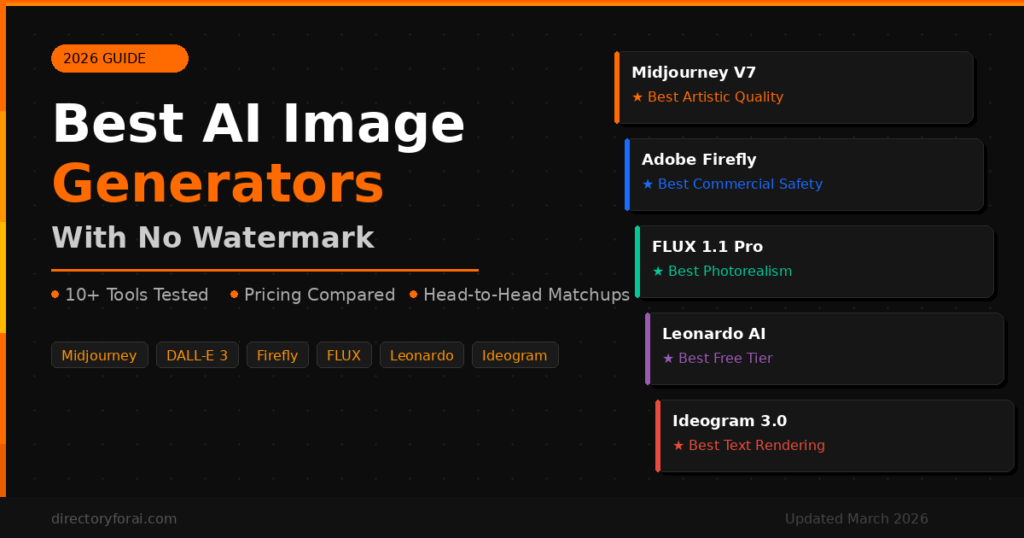
Final Rankings: Best AI Image Generators With No Watermark (March 2026)
Best overall artistic quality: Midjourney V7 ($30/month Standard). Source: Revoyant 2026 review (https://www.revoyant.com/blog/midjourney-review), DataSkater 2026 comparison (https://www.dataskater.com/best-ai-image-generators-2026/)
Best free tool overall: Leonardo AI free tier (150 tokens/day, no watermark, commercial use). Source: AI Tool Analysis (https://aitoolanalysis.com/leonardo-ai-review-2025/)
Best for commercial and legal safety: Adobe Firefly Standard ($9.99/month). Source: Complex Discovery 2026 (https://complexdiscovery.com/adobes-legally-grounded-ai-model-offers-a-blueprint-for-responsible-innovation/)
Best for text inside images: Ideogram 3.0 ($8/month or free tier). Source: MindStudio (https://www.mindstudio.ai/blog/choosing-image-generation-model), Leonardo AI model guide (https://leonardo.ai/news/ai-image-models/)
Fastest high-quality generation: FLUX.1.1 Pro (4.5 seconds per image via API). Source: Gradually.ai (https://www.gradually.ai/en/ai-image-models/)
Best per-image cost on paid tier: Leonardo AI Apprentice ($12/month, ~$0.0014 per image). Source: Axis Intelligence (https://axis-intelligence.com/ai-image-generators-2026-honest-comparison/)
Best for developers and programmatic access: Stable Diffusion 3.5 or FLUX API. Source: MindStudio (https://www.mindstudio.ai/blog/choosing-image-generation-model)
Best ecosystem integration for Adobe users: Adobe Firefly (included with Creative Cloud). Source: Adobe docs (https://helpx.adobe.com/firefly/web/whats-new/new-features/whats-new.html)
Best ecosystem integration for Microsoft users: Microsoft Designer (free with Microsoft account, visible watermark on free tier). Source: Revoyant (https://www.revoyant.com/blog/best-ai-image-generators)
Best for game developers and character consistency: Leonardo AI. Source: AI Tool Analysis (https://aitoolanalysis.com/leonardo-ai-review-2025/)
Key Takeaways
The watermark era is effectively over for any tool you are willing to pay $10-30 per month for. Every major paid tier delivers clean, watermark-free downloads. The real decision in 2026 is about commercial licensing clarity, output quality for your specific use case, volume needs, and whether your workflow integration context determines your tool choice before artistic quality even enters the equation.
The legal environment has shifted faster than most users realize. The US Supreme Court confirmed in March 2026 that purely AI-generated images cannot be copyrighted. Disney, Universal, and Warner Bros. have filed major lawsuits against Midjourney that are progressing through discovery. Adobe faces a narrower lawsuit over language model training data. Understanding these risks is not optional for professional use.
The practical hierarchy for most users: start with Leonardo AI’s free tier. If you need private generation, move to Apprentice at $12/month. If you need the best artistic quality and can accept legal ambiguity, move to Midjourney Standard. If you need licensed training data with legal indemnification, use Adobe Firefly. If you need text in images, use Ideogram. If you need speed and photorealism via API, use FLUX.
Everything else is optimization around a workflow you will discover through actual use.
X vs Y Head-to-Head Matchups, Every Major Pair Compared
This section compares each major AI image generator pair across the dimensions that actually drive decisions: output quality, pricing model, commercial licensing, ease of use, speed, and who wins for which type of user. These are not opinion pieces. Each verdict is grounded in benchmark data, community consensus, and independently verified feature comparisons sourced from hands-on testing as of March 2026.
Matchup 1: Midjourney vs DALL-E 3 (GPT-4o)
These two tools represent opposite ends of the ease-to-artistry spectrum. Midjourney is the tool that makes images look like they came from a professional artist’s portfolio. DALL-E 3 is the tool that does exactly what you ask it to do.
Image quality: In blind tests on Midjourney’s Discord arena, users identified V6 outputs as “real photos” 41% of the time versus 23% for DALL-E 3. Midjourney won 73% of human preference tests against DALL-E 3 for realistic portraits. Cabina However, that comparison measures aesthetic preference, not literal accuracy. Midjourney produces more artistic, gallery-quality images, while DALL-E 3 is better for precise, literal interpretations and beginner-friendly use. Fortune Business Insights
Photorealism benchmarks: GPT Image 1.5 (DALL-E 3’s successor) achieves 87% photorealistic accuracy, meaning roughly 9 out of 10 photorealistic prompts produce believable results. Midjourney V7 produces images with superior artistic composition and lighting, but its estimated LM Arena Elo score sits around 1200, below GPT Image 1.5’s score of 1264. Midjourney The distinction matters: Midjourney looks more beautiful; DALL-E 3 more accurately replicates what you describe.
Text rendering: Text rendering requires architecture specifically trained on text-image relationships. Midjourney V6’s diffusion model treats text as visual patterns, not semantic content, resulting in garbled output the vast majority of the time. DALL-E 3 and Ideogram solve this with dedicated text encoding modules. Cabina
Pricing comparison:
- Midjourney: No free tier. Entry at $10/month for approximately 200 images.
- DALL-E 3 via ChatGPT Plus: $20/month, bundled with GPT-4o access. If you already pay for ChatGPT Plus, the incremental cost of image generation is zero.
API access: DALL-E 3 offers an API, batch processing, and better text rendering. Midjourney has no API, no model weights, and no local deployment tools. The service is exclusively cloud-based via Discord or web interface. ControlNet
Commercial licensing: Both provide full commercial rights on paid tiers. DALL-E 3 (via OpenAI’s updated 2026 terms) explicitly grants output ownership to the user. Midjourney requires paid subscription for commercial use and imposes revenue thresholds ($1M+ annual revenue requires Pro or Mega).
Workflow: DALL-E 3’s strength is described as “ease of use, accessibility, and text rendering.” Midjourney’s strength is “producing images that look like they came out of a high-end magazine or a concept art portfolio.” The Discord-based workflow remains “clunky compared to a proper web app,” even after the launch of the Midjourney web interface. Cybernews
Winner overall artistic quality: Midjourney. Winner ease of use and text rendering: DALL-E 3. Winner for developers: DALL-E 3 (has an API; Midjourney does not).
Best for: Use Midjourney if artistic quality is the primary criterion and you tolerate subscription-only access with no API. Use DALL-E 3 if you need accurate, reliable, conversationally-refined images, readable text in outputs, or programmatic integration. If you already pay for ChatGPT Plus, the decision is made for you.
Source: UCStrategies (https://ucstrategies.com/news/midjourney-v6-photorealism-specs-pricing-discord-workflow-2026/), LaoZhang AI Blog (https://blog.laozhang.ai/en/posts/nano-banana-2-vs-midjourney-vs-gpt-image-vs-flux2), pxz.ai (https://pxz.ai/blog/best-ai-image-generators-2025-tested-ranked), FreeAcademy (https://freeacademy.ai/blog/midjourney-vs-dalle-vs-stable-diffusion-vs-flux-comparison-2026)
Matchup 2: Midjourney vs Stable Diffusion
Midjourney gives you speed and serendipity, while Stable Diffusion delivers surgical precision — if you’re willing to learn the vocabulary. Bright SEO Tools This comparison is less about which produces better images and more about which model of creative control fits your workflow.
Image quality head-to-head: Midjourney excels at surrealism, fantasy art, character design, and atmospheric landscapes. These outputs often require little post-processing before being used in blogs, campaigns, or concept art. Stable Diffusion takes the opposite approach by providing an open-source architecture with extensive user control. Community models like SDXL, DreamShaper, and RealisticVision expand Stable Diffusion’s range, covering photorealism, anime, cinematic effects, and more. Upsampler
Customization: The strength of Stable Diffusion is its near-infinite flexibility. Thanks to a massive community library of LoRAs and custom checkpoints, you can replicate almost any style imaginable. From obscure art movements to the signature look of a single artist, this granular control is perfect for projects that demand a very specific visual identity. It’s estimated that over 12.59 billion images will be generated with Stable Diffusion by 2026, accounting for roughly 80% of all AI-generated images. Bright SEO Tools
Speed: Midjourney runs entirely on its hosted infrastructure. Generation typically takes 30 to 90 seconds per image, depending on server load. Fast mode provides near-instant outputs. Stable Diffusion performance depends on hardware. Local users with a high-end GPU with 24GB VRAM can generate images in under a minute. Lower-powered systems may take several minutes per render. Upsampler
Commercial rights: Midjourney: if you have any paid plan, you get broad commercial rights to the images you generate. Stable Diffusion: the base models are usually permissive, but the incredible variety you see online comes from a vast ecosystem of custom models and LoRAs. Many are shared with strict non-commercial licenses. Before using any Stable Diffusion image commercially, you must check the license for every single component — the main model, any LoRAs, and any other assets that went into the final image. Bright SEO Tools
Cost math: If you’re casual (under 200 images per month): Midjourney Basic at $10 is probably cheaper than buying a GPU. If you’re serious (500+ images per month): Stable Diffusion pays for itself in under a year. If you’re professional (thousands of images): Stable Diffusion isn’t even a question. Vizologi
Setup barrier: Setting up Stable Diffusion cost me like 6 hours of my life I’m never getting back. Midjourney: I just tested it in less time than making coffee. Vizologi Community consensus is consistent: Midjourney wins on time-to-first-image. Stable Diffusion wins on time-to-thousandth-image.
Stable Diffusion is more consistent, user-friendly, and accessible, with better pricing and a more comprehensive ownership and ethical policy. Midjourney delivers good core features and superior customer support quality. Aitooldiscovery
Winner for beginners and casual creators: Midjourney. Winner for high-volume technical users: Stable Diffusion. Winner for commercial licensing simplicity: Midjourney. Winner for cost efficiency at scale: Stable Diffusion by a wide margin.
Best for: Choose Midjourney when you need consistently beautiful images with minimal setup and your volume is under 500 images per month. Choose Stable Diffusion when you need full technical control, privacy, unlimited volume, or when building AI image generation into an application or pipeline.
Source: AI Image Detector (https://www.aiimagedetector.com/blog/stable-diffusion-vs-midjourney), pxz.ai (https://pxz.ai/blog/midjourney-vs-stable-diffusion), DataStudios (https://www.datastudios.org/post/midjourney-vs-stable-diffusion-image-quality-speed-and-pricing-compared), TechnologyAdvice/eWeek (https://www.eweek.com/artificial-intelligence/midjourney-vs-stable-diffusion/)
Matchup 3: Adobe Firefly vs Leonardo AI
The ultimate winner in this showdown is the creator, who now has two world-class tools perfectly tailored to opposite ends of the professional creative spectrum. PXZ AI That is the honest framing. These tools are not competing for the same user.
Output style: Adobe Firefly excels at generating images that are clean, polished, and photorealistic. Its output often has a distinct, high-production-value look that is immediately suitable for marketing materials, product mockups, and corporate design. The results are consistently high-resolution and maintain a professional, un-AI-like finish. PXZ AI Leonardo AI, by contrast, offers a wider variety of models and avoids the generic “stocky” look that commercial training data can produce. Features like Character Reference allow you to maintain a consistent character across different scenes without complex fine-tuning — a workflow that remains difficult in Firefly’s ecosystem. Perpetio
Commercial licensing: Adobe’s approach to commercial use is its strongest selling point for enterprise clients. Firefly is trained exclusively on Adobe Stock images, public domain content, and licensed content, ensuring that generated images are free from IP conflicts. Adobe offers legal indemnification for content created with Firefly, meaning Adobe will cover the legal costs if a third party claims copyright infringement. This is a massive advantage for large corporations and professional agencies who cannot risk IP disputes. Leonardo AI’s policy is highly favorable to the creator, but it lacks the explicit legal indemnity offered by Adobe. PXZ AI
Free tier: Leonardo AI’s free tier (150 tokens per day) is genuinely useful. Adobe Firefly’s free tier provides only 25 credits per month, which limits meaningful experimentation. At the $12/month Apprentice tier, Leonardo AI pays for itself if you generate 50+ images weekly. Toools.design
G2 and Capterra community scores: G2 reviewers report that Adobe Firefly excels in user satisfaction, boasting a significantly higher overall score compared to Leonardo AI. Users appreciate its intuitive interface, noting that the learning curve is quick and short. Adobe Firefly has 184 recent reviews compared to Leonardo AI’s 2, indicating a broader range of current user experience data. Skywork However, Leonardo AI shines in providing users with full ownership of generated content. Users also appreciate the non-expiring API credits, which support long-term planning and collaboration. Skywork
Workflow integration: Adobe Firefly’s integration with popular Adobe applications like Photoshop, Illustrator, and Lightroom allows seamless incorporation of AI-generated content into broader design projects. Leonardo AI includes tools such as AI Canvas for image editing and 3D Texture Generation, features not available in Adobe Firefly. SourceForge
There is no single winner. Both tools dominate different creative needs. If you need cinematic images, character design, detailed portraits, fantasy or sci-fi concepts — Leonardo is unmatched. If you create logos, social graphics, banners, templates, YouTube thumbnails, or business assets — Firefly is the clear winner. AI:PRODUCTIVITY
Winner for legal safety and enterprise teams: Adobe Firefly. Winner for volume, customization, and independent artists: Leonardo AI. Winner on free tier generosity: Leonardo AI by a substantial margin (150 tokens/day vs 25 credits/month).
Best for: If you are a professional designer or marketing agency already in the Adobe Creative Cloud ecosystem and your primary concern is commercial safety and Photoshop integration, Firefly is the natural choice. If you are an independent artist, game developer, or concept artist who values artistic freedom, custom model training, and high-volume generation at low cost, Leonardo AI is the stronger platform.
Source: AI App Genie (https://aiappgenie.com/post/adobe-firefly-vs-leonardo-ai), OpenArt (https://openart.ai/blog/post/leonardo-ai-vs-adobe-firefly), G2 (https://www.g2.com/compare/adobe-firefly-vs-leonardo-ai), AI Productivity (https://aiproductivity.ai/vs/adobe-firefly-vs-leonardo/), Leonardo AI (https://leonardo.ai/news/adobe-firefly-alternative/)
Matchup 4: FLUX vs Midjourney
This is the matchup the AI image community is most actively debating in 2026. FLUX came from former Stability AI researchers and launched in late 2024. By early 2026, it had become the benchmark for photorealism.
Benchmark scores: GPT Image 1.5 and FLUX.2 Pro v1.1 share the top position in LM Arena benchmark rankings, with Elo scores of 1264 and 1265 respectively as of March 2026. These scores are remarkably close, suggesting both models have reached a similar ceiling for photorealistic image generation as measured by current evaluation methodologies. Midjourney Midjourney does not participate in standardized benchmarks, which makes direct comparison harder, but its estimated Elo is approximately 1200 — below both.
Photorealism test results: For prompt accuracy and photorealism, Flux 2 outperforms Midjourney V7 by a meaningful margin. For artistic quality and visual sophistication, Midjourney remains superior. Saaspricepulse One reviewer who ran 500+ prompts across both tools described the practical difference clearly: Flux 2 is the clear winner for photorealism. The photorealism, prompt adherence, and consistency make it the most reliable choice for e-commerce product shots, real estate photography, and any situation where the image needs to look like a real photograph. Midjourney V7, no contest, for concept art, illustrations, book covers, or any visual where artistic expression matters more than literal accuracy. Saaspricepulse
Tom’s Guide head-to-head: Midjourney wins for the realism of the main character in portrait tests. It isn’t perfect — the dynamism of the Flux image is preferred — but the challenge is creating accurate humans and Midjourney is closer with better skin texture. CometAPI
A 100-prompt benchmark from one independent tester: Midjourney aced artistic quality with 92% preference in blind art tests. Flux achieved 88% preference in photorealistic tests. Flux nailed human portraits 9 out of 10 times versus Midjourney’s 6 out of 10 in pure photorealism prompts. Fueler
Speed: FLUX.1.1 Pro leads in 2026 with the highest technical quality and a 4.5-second generation time, ideal for realism and commercial use. Glbgpt Midjourney Standard mode takes 15-30 seconds per image.
API access: FLUX is fully available via API at approximately $0.02-$0.04 per image through providers. Midjourney prohibits automated API access entirely.
Licensing: For commercial use, Adobe Firefly and FLUX.1 Schnell are legally safest — both use licensed training data. Glbgpt Midjourney faces active litigation over training data from Disney, Universal, and Warner Bros.
Cost structure: FLUX via API costs approximately $0.04 per image. Midjourney Standard at $30/month works out to roughly $0.006 per image at high Relax mode volume but has no API equivalent.
Winner for photorealism and API access: FLUX. Winner for artistic quality and aesthetic depth: Midjourney. Winner on speed: FLUX (4.5 seconds vs 15-30 seconds). Winner on commercial legal safety: FLUX.
Best for: Choose FLUX when you need photorealistic product shots, realistic portraits, developer API access, or the fastest generation times. Choose Midjourney when you want images that have the distinctive visual quality of professional editorial or concept art work, and you do not need programmatic access.
Source: Gradually.ai (https://www.gradually.ai/en/ai-image-models/), LaoZhang AI (https://blog.laozhang.ai/en/posts/nano-banana-2-vs-midjourney-vs-gpt-image-vs-flux2), Tom’s Guide (https://www.tomsguide.com/ai/ai-image-video/i-tested-flux-vs-midjourney-to-see-which-ai-image-generator-is-best-heres-the-winner), Apatero (https://apatero.com/blog/dalle-vs-midjourney-vs-flux-comparison-2026), Emerging Tech Daily (https://www.emergingtechdaily.com/post/midjourney-vs-flux-vs-ideogram-2026-best-pick)
Matchup 5: DALL-E 3 vs Ideogram
Both tools care about one thing their competition ignores: putting readable words inside images. But they go about it differently, and the gap between them on this specific task is larger than most people realize.
Text rendering accuracy: Ideogram’s text rendering is revolutionary. It reliably generates correct spelling at 95%+ accuracy versus 30-50% with other tools, handles complex typography including multiple text elements and stylized fonts, and accurately integrates long sentences of 10+ words. Example: the prompt “Create a vintage poster with the text ‘SUMMER FESTIVAL 2026’ in bold retro typography” — Ideogram renders the text perfectly integrated into a retro aesthetic. Skyquestt
Ideogram reduces the text error rate by nearly half compared to DALL-E 3. Midjourney is worse than DALL-E 3 when it comes to text rendering. In benchmarks conducted by Ideogram, people rated images generated by Ideogram better than those from DALL-E 3 and Midjourney in all areas, with text rendering being the biggest advantage. Grand View Research
GPT Image 1.5 (the current DALL-E successor) leads with exceptional text rendering across all scenarios, treating text as linguistic information rather than just visual patterns. Ideogram 3.0 achieves 90% text rendering accuracy through dedicated text-processing mechanisms built by former Google Brain researchers. The Business Research Company
The honest difference: Ideogram was built from the ground up to solve text rendering. GPT Image 1.5 solved it as part of a general multimodal architecture improvement. In practice, Ideogram at 95% accuracy beats GPT Image 1.5 at 90% for typography-heavy design work. But for broader image quality and artistic range, DALL-E 3/GPT-4o Image is stronger.
Overall image quality: DALL-E 3 generally delivers more visually refined images. Lighting, depth, and composition often feel more natural, especially in complex or cinematic scenes. Ideogram’s images are cleaner and more minimal. While they may lack the artistic depth of DALL-E 3, they are well-suited for practical design tasks. DALL-E 3 leads in artistic quality; Ideogram focuses on clarity and structure. GI Research
Free tier: Ideogram offers 10 slow credits per week on the free tier (watermark-free, no commercial use). DALL-E 3 is available free with limitations via Bing Image Creator (with visible watermark) or through ChatGPT’s free tier.
Pricing: Ideogram Plus: $8/month. DALL-E 3 via ChatGPT Plus: $20/month (bundled with full GPT-4o access). If you need ONLY image generation with text accuracy: Ideogram at $8/month wins on value. If you need image generation as part of a broader AI workflow: ChatGPT Plus at $20/month wins on breadth.
Winner for text in images: Ideogram decisively, at 95% text accuracy versus 30-50% for most alternatives. Winner for overall image quality and artistic range: DALL-E 3 / GPT-4o Image. Winner on standalone pricing: Ideogram ($8/month for a dedicated tool vs $20/month for ChatGPT bundled access).
Best for: Posters, banners, logos, social media graphics, and any image where text must be readable: Ideogram, full stop. Complex cinematic prompts, conversational image refinement, and general-purpose image generation: DALL-E 3 via ChatGPT.
Source: The Decoder (https://the-decoder.com/ideogram-1-0-outshines-midjourney-and-dall-e-3-with-impressive-text-rendering/), MindStudio (https://www.mindstudio.ai/blog/choosing-image-generation-model), TechVernia (https://techvernia.com/pages/reviews/image/ideogram.html), Picwand AI (https://www.picwand.ai/ai-generation/ideogram-vs-dall-e-3/), All About AI (https://www.allaboutai.com/comparison/ideogram-vs-dall-e-3/)
Matchup 6: Adobe Firefly vs DALL-E 3
Two tools with similar output aesthetics — clean, professional, accurate — and completely different ecosystem strategies. Choosing between them is almost entirely an ecosystem question.
Output quality comparison: Adobe seems to have tuned Firefly toward safety and realism at the cost of creative range. Highly stylized or fantastical imagery comes out more bland. DALL-E 3’s aesthetic range is also narrower than Midjourney, with images that tend to have a recognizable clean look that is somewhat generic. Where DALL-E 3 struggles is less restraint and more “photorealism lags behind Midjourney and Firefly.” Both tools prioritize accuracy over artistry. Cybernews
Prompt adherence: For precise prompt execution, GPT Image 1.5 understands best what you really want and is unmatched for complex instructions. Adobe Firefly Image 4 produces competent but conservative results with strong accuracy on standard prompts. Glbgpt
Commercial safety: Adobe Firefly has the edge on legal defensibility. Its training data is licensed Adobe Stock and public domain content with legal indemnification on enterprise tiers. DALL-E 3 grants commercial rights via OpenAI’s terms of service but does not provide the same documented provenance or legal indemnification.
Ecosystem lock-in: Adobe Firefly integrates directly into Creative Cloud — Generative Fill in Photoshop, text-to-image in Express, audio translation for video in Premiere. For in-house design teams already on Creative Cloud who want provenance and edit-in-Photoshop workflows, Firefly is the natural default. BestPhoto DALL-E 3 integrates into Microsoft Copilot, ChatGPT, Word, PowerPoint, and Teams. If you live in Microsoft 365, DALL-E 3 is your native generator.
Pricing: Adobe Firefly Starter at $4.99/month or included with Creative Cloud. DALL-E 3 via ChatGPT Plus at $20/month. For standalone image generation without other subscriptions, Firefly is the cheaper entry point. For users who already pay for ChatGPT Plus for other purposes, DALL-E 3 is effectively free.
Video and expansion: Adobe added Black Forest Labs’ FLUX.2 for image generation and launched a full video editor in beta. OpenAI’s DALL-E successor GPT Image 1.5 generates both standard images and image edits including inpainting with people. Research And Markets Both platforms are expanding beyond static image generation rapidly.
Winner for Adobe Creative Cloud users: Firefly, clearly. Winner for Microsoft 365 or ChatGPT users: DALL-E 3, clearly. Winner on legal indemnification: Firefly. Winner on prompt accuracy benchmarks: DALL-E 3 / GPT Image 1.5 (LM Arena Elo 1264 vs Firefly’s estimated position below that).
Best for: The decision is almost entirely made by your existing ecosystem. Adobe users default to Firefly. Microsoft/OpenAI users default to DALL-E 3. Neither tool is compelling enough to justify switching ecosystems if you are already invested in the other.
Source: Techno-Pulse (https://www.techno-pulse.com/2026/03/best-ai-image-generators-in-2026.html), MindStudio (https://www.mindstudio.ai/blog/choosing-image-generation-model), Gradually.ai (https://www.gradually.ai/en/ai-image-models/), AI/ML API (https://aimlapi.com/blog/the-best-ai-image-generators)
Matchup 7: Leonardo AI vs DALL-E 3
Two tools that are both strong for volume production and both offer clean, watermark-free commercial outputs. The differentiation comes down to feature breadth versus conversational simplicity.
Output style: Leonardo AI’s Phoenix and Lucid models lean toward cinematic and high-detail artistic outputs. DALL-E 3 defaults to clean, literal interpretations with minimal artistic embellishment. For a prompt like “editorial portrait of a woman in natural light,” Leonardo AI tends to produce a more stylized, visually dramatic result. DALL-E 3 tends to produce a more accurate, less visually distinct result.
Feature breadth: Leonardo AI combines high-end image generation, a real-time sketching canvas, video animation, and a Photoshop-style editor into one platform. For game developers, web designers, and power users, it is the clear winner in terms of feature breadth. Perpetio DALL-E 3 generates images through conversational prompting and provides image editing. It does not offer a canvas, custom model training, or video animation.
Character consistency: Leonardo AI offers Character Reference tools that maintain visual consistency across multiple generations of the same character, which is a production-level workflow feature unavailable in DALL-E 3’s current interface.
Free tier value: Leonardo AI provides 150 tokens per day on its free tier — effectively 150 usable images daily with commercial rights. DALL-E 3’s free access via ChatGPT has no published daily image limit but is constrained by message rate limits and produces outputs with a visible watermark via Bing Image Creator’s free tier. For pure free-tier volume, Leonardo AI wins by a wide margin.
Pricing comparison:
- Leonardo AI Apprentice: $12/month for 8,500 tokens per month (~$0.0014 per image)
- DALL-E 3 via ChatGPT Plus: $20/month with fair use image cap
For volume production at low per-image cost, Leonardo AI at $12/month is more economical. For users who already use ChatGPT for other work, DALL-E 3 is the better integrated option.
Text rendering: Neither platform matches Ideogram. DALL-E 3 is measurably stronger than Leonardo AI on text inside images. Leonardo AI’s Phoenix model improved text accuracy in late 2025, but the gap versus DALL-E 3 remains significant for complex typography.
Winner on free tier volume: Leonardo AI (150/day vs effectively zero usable clean free images from DALL-E 3). Winner on ease of use: DALL-E 3 (conversation-driven vs parameter-heavy interface). Winner on feature breadth: Leonardo AI. Winner on per-image cost at entry paid tier: Leonardo AI by approximately 10x.
Best for: Game developers, concept artists, and high-volume creators who need feature breadth and low cost: Leonardo AI. Users who want conversational simplicity, minimal setup, and are already in the ChatGPT ecosystem: DALL-E 3.
Source: Perpetio (https://perpet.io/blog/which-ai-image-generator-to-choose-dall-e-3-vs-adobe-firefly-vs-midjourney-vs-leonardo-ai/), Axis Intelligence (https://axis-intelligence.com/ai-image-generators-2026-honest-comparison/), AI Tool Analysis (https://aitoolanalysis.com/leonardo-ai-review-2025/)
Matchup 8: Midjourney vs Ideogram
This matchup is the most asymmetric on this list. Midjourney is the artistic quality benchmark. Ideogram is the text-rendering benchmark. They serve almost entirely different use cases.
Where Midjourney wins: Atmospheric compositions, editorial portraits, fantasy and sci-fi concept art, fashion imagery, and any prompt where visual impact, mood, and aesthetic quality are the primary goals. Midjourney aced artistic quality with 92% preference in blind art tests. Fueler
Where Ideogram wins: Any design that includes text. Logos, poster designs, social media graphics with slogans, branded banners, packaging mockups. Ideogram’s text rendering is revolutionary. It reliably generates correct spelling at 95%+ accuracy versus 30-50% for Midjourney, which still treats text as visual patterns rather than semantic content. Skyquestt
If you need text in images, Ideogram is specifically designed for this and produces the best text rendering for logos. For professional logo work with text elements, Midjourney is not a viable tool in most cases. Fortune Business Insights
Price: Ideogram free tier (10 credits/week) vs Midjourney minimum $10/month. Ideogram Plus at $8/month is less expensive than Midjourney Basic at $10/month.
Privacy: Ideogram free tier keeps images private by default — an uncommon free-tier benefit. Midjourney Basic keeps images public by default (Stealth Mode requires Pro at $60/month).
The overlap: Both tools can produce high-quality general images. For non-text photographic or artistic prompts, Midjourney is clearly superior. For anything requiring readable typography, Ideogram is the only practical choice.
Winner for artistic quality: Midjourney by a wide margin. Winner for typography and text-in-image: Ideogram by an equally wide margin. Winner on price entry: Ideogram. Winner on privacy at free tier: Ideogram.
Best for: Midjourney for creative professionals who generate text-free atmospheric, editorial, or concept art. Ideogram for designers and marketers who need posters, banners, social graphics, and logos where text accuracy determines whether the output is usable.
Source: Emerging Tech Daily (https://www.emergingtechdaily.com/post/midjourney-vs-flux-vs-ideogram-2026-best-pick), TechVernia (https://techvernia.com/pages/reviews/image/ideogram.html), CompareGen AI (https://www.comparegen.ai/blog/best-ai-image-generators-2026)
Matchup 9: FLUX vs Stable Diffusion
Both tools share DNA — the team at Black Forest Labs that built FLUX came directly from Stability AI, the company behind Stable Diffusion. Their underlying architectures reflect a shared lineage. The comparison is between a polished commercial successor and a battle-tested open-source ecosystem.
Output quality: FLUX.1.1 Pro leads in 2026 with the highest technical quality of all available models and a 4.5-second generation time, ideal for realism and commercial use. Stable Diffusion 3.5 replaced older models like SDXL and Stable Cascade as the flagship open-source release, representing a significant leap forward. Glbgpt
FLUX is particularly well-suited for photographers, content creators, and marketing experts who need realistic images without compromising on quality. Stable Diffusion 3.5 offers maximum flexibility and the full benefits of the open-source community: customization through LoRA fine-tuning, ControlNet conditioning, and complete control over the generation process. Zapier
Customization depth: Stable Diffusion wins on pure customization breadth. The community ecosystem of LoRAs, custom checkpoints, ControlNet configurations, and ComfyUI workflows represents a level of fine-tuning control that FLUX’s current tooling does not match. However, FLUX’s open-weight Dev version is itself fine-tunable and improving rapidly. Stable Diffusion with a custom LoRA trained on specific product photos gives the most control and consistency. FLUX Pro is an excellent alternative for high-quality product shots without training. AI Tools Sme
Licensing: Stable Diffusion 3.5 uses a community license allowing commercial use. FLUX.1 Schnell uses the permissive Apache 2.0 license, making it one of the most commercially open models available. ControlNet Both are usable commercially for most use cases without subscription.
Infrastructure: Stable Diffusion’s SD 3.5 Medium model (2.5B parameters) runs on consumer GPUs with only approximately 10GB VRAM required. FLUX’s Dev version similarly runs on consumer hardware, with the Pro version requiring cloud API access. Pixelbin
Speed: FLUX 1.1 Pro at 4.5 seconds per image via API is faster than typical Stable Diffusion local generation (3-10 seconds on an RTX 3080). FLUX 2 Schnell at 2-3 seconds is faster still, making it viable for near-real-time applications.
Ecosystem maturity: Stable Diffusion’s ecosystem — built over several years — includes the most comprehensive library of community models, training resources, and customization tools of any AI image platform. FLUX’s ecosystem is newer but growing rapidly due to the quality of the base model.
Winner on raw output quality: FLUX.1.1 Pro by benchmark. Winner on customization and community ecosystem: Stable Diffusion. Winner on licensing simplicity: Both are commercially permissive. Winner on generation speed: FLUX. Winner on cost at very high volume with owned hardware: Stable Diffusion (no per-image fees beyond hardware).
Best for: Use FLUX when you need the highest-quality open-weight photorealism via API without the setup overhead of self-hosting, or when you need speed. Use Stable Diffusion when you need the deepest customization control, the widest range of community-trained models, and full privacy with zero ongoing cost after hardware investment.
Source: FreeAcademy (https://freeacademy.ai/blog/midjourney-vs-dalle-vs-stable-diffusion-vs-flux-comparison-2026), Gradually.ai (https://www.gradually.ai/en/ai-image-models/), MindStudio (https://www.mindstudio.ai/blog/choosing-image-generation-model)
Matchup 10: Midjourney vs Adobe Firefly (Enterprise Focus)
This matchup is covered briefly in the earlier section of the article, but it warrants a more detailed enterprise-focused treatment given how different the risk profiles are for business users.
Legal exposure: Midjourney faces three active major entertainment lawsuits — Disney, Universal, and Warner Bros. all filed in 2025. The Disney and Universal lawsuit alone is 110 pages and alleges Midjourney functions as a “virtual vending machine generating endless unauthorized copies.” Adobe Firefly is trained on licensed Adobe Stock imagery. Its only active legal challenge is a separate class action over its language models (not Firefly’s image generation), filed in December 2025. For enterprise legal teams, the risk differential is not subtle.
Brand safety filtering: Firefly’s conservative content filters align with enterprise brand safety requirements. Midjourney’s content moderation is less restrictive, which is a feature for artists and a liability for brands that need to guarantee clean output for all employees using the tool.
Workflow integration: Midjourney is a standalone tool — generate, download, use elsewhere. Firefly is embedded in Photoshop (Generative Fill), Illustrator (Text to Vector), Premiere Pro (Generative Extend), and Express. For a design team that spends its day in Creative Cloud, this is not a minor convenience — it eliminates the context switching that consumes significant work time.
Output aesthetics for marketing: For editorial or atmospheric imagery, Midjourney delivers results that feel intentional rather than generated. Adobe Firefly outputs tend to be competent but conservative — it prioritizes safety and consistency over artistic range. BestPhoto For corporate marketing materials (product shots, clean brand assets, presentation visuals), Firefly’s conservatism is an advantage. For fashion editorials, mood boards, and campaign hero images, Midjourney’s artistry wins.
Pricing at enterprise scale: Adobe Firefly Premium at $199.99/month provides 50,000 credits. Midjourney Pro at $60/month provides 30 Fast GPU hours. For teams generating thousands of images per month, Firefly’s credit model is cheaper per image at scale. For teams needing the highest artistic quality with unlimited Relax mode, Midjourney Standard at $30/month remains competitive.
Winner for enterprise risk-averse use: Adobe Firefly decisively. Winner for creative agencies prioritizing artistic output: Midjourney. Winner on price entry: Firefly ($4.99/month Starter vs $10/month Midjourney Basic). Winner on Creative Cloud workflow integration: Firefly, no comparison.
Best for: Enterprise marketing teams, agencies with active legal review, and any organization where a single IP dispute would be catastrophic should default to Firefly. Creative studios, editorial publishers, and independent designers where artistic quality is the primary commercial value delivered should use Midjourney Standard.
Source: AI App Genie (https://aiappgenie.com/post/adobe-firefly-vs-leonardo-ai), Medium/Markus Brinsa (https://medium.com/@markus_brinsa/midjourney-vs-adobe-firefly-six-months-later-same-fight-thicker-lawsuit-stack-401fc6d43a86), NPR (https://www.npr.org/2025/06/12/nx-s1-5431684/ai-disney-universal-midjourney-copyright-infringement-lawsuit), Tools.Design (https://www.toools.design/blog-posts/ai-tools-for-graphic-design), Cliprise (https://www.cliprise.app/learn/comparisons/platforms/top-5-midjourney-alternatives-2026)
Matchup Summary Table: Quick Decision Reference
| Matchup | Winner Category | Winner | Runner-Up |
|---|---|---|---|
| Midjourney vs DALL-E 3 | Artistic quality | Midjourney | DALL-E 3 |
| Midjourney vs DALL-E 3 | Text rendering | DALL-E 3 | Ideogram |
| Midjourney vs DALL-E 3 | API access | DALL-E 3 | N/A (MJ has no API) |
| Midjourney vs Stable Diffusion | Ease of use | Midjourney | N/A |
| Midjourney vs Stable Diffusion | Volume cost efficiency | Stable Diffusion | N/A |
| Midjourney vs Stable Diffusion | Commercial licensing clarity | Midjourney | N/A |
| Adobe Firefly vs Leonardo AI | Legal safety / indemnification | Adobe Firefly | N/A |
| Adobe Firefly vs Leonardo AI | Free tier volume | Leonardo AI | N/A |
| Adobe Firefly vs Leonardo AI | Feature breadth | Leonardo AI | N/A |
| FLUX vs Midjourney | Photorealism benchmarks | FLUX | Midjourney |
| FLUX vs Midjourney | Artistic quality | Midjourney | FLUX |
| FLUX vs Midjourney | Generation speed | FLUX (4.5 sec) | N/A |
| DALL-E 3 vs Ideogram | Text rendering accuracy | Ideogram (95%) | DALL-E 3 (90%) |
| DALL-E 3 vs Ideogram | Overall image quality | DALL-E 3 | Ideogram |
| Adobe Firefly vs DALL-E 3 | Adobe ecosystem fit | Adobe Firefly | N/A |
| Adobe Firefly vs DALL-E 3 | Microsoft/OpenAI ecosystem fit | DALL-E 3 | N/A |
| Leonardo AI vs DALL-E 3 | Per-image cost (paid tier) | Leonardo AI | N/A |
| Leonardo AI vs DALL-E 3 | Ease of use | DALL-E 3 | N/A |
| Midjourney vs Ideogram | Artistic quality | Midjourney | N/A |
| Midjourney vs Ideogram | Typography accuracy | Ideogram | N/A |
| FLUX vs Stable Diffusion | Raw output quality | FLUX | Stable Diffusion |
| FLUX vs Stable Diffusion | Customization depth | Stable Diffusion | FLUX |
| Midjourney vs Firefly (Enterprise) | Legal/IP risk management | Adobe Firefly | N/A |
| Midjourney vs Firefly (Enterprise) | Editorial artistic output | Midjourney | N/A |